Gold Prices Fall 1.3%, but Sentiment Improvement Remains Significant
① One-Sentence Summary This Week
Gold fell 1.3% for the week, failing to maintain the ¥4,500 level. While Commitment of Traders (COT) data showed a slight decrease, post-adjusted news sentiment improved clearly from the bearish tone of the previous week. Despite the headwind of rising real interest rates, gold has not broken down decisively, and the key question now is whether buying pressure remains on pullbacks rather than focusing on the strength of any potential rallies.
② Price Trends and Chart Review
This week’s weekly OHLC data, sourced from the yfinance futures series, declined from an opening price of $4,466.5 on September 7th to a closing price of $4,408.9 on September 11th. The weekly gain/loss percentage was -1.2896%. The week’s high reached $4,488.8, while the low was $4,333.0, resulting in a range of $155.8 and a range of 3.4882% from the opening price. It failed to reach the $4,500 level, pausing the upward trend. However, it closed the week up over $75 from the low, indicating it was not a complete sell-off.
Looking at the levels slightly differently, the closing price is up +1.3168% compared to three months ago and +20.9845% compared to one year ago. Within the past three years, it sits at the 82.39 percentile, suggesting a continued long-term upward trend. The 20-day annualized volatility is 23.7135%, placing it in the 80.08 percentile over the past three years. In other words, the price level is high, and volatility is in the top 20%. Rather than chasing it based on its height, the focus should be on assessing the quality of pullbacks, factoring in the volatility.
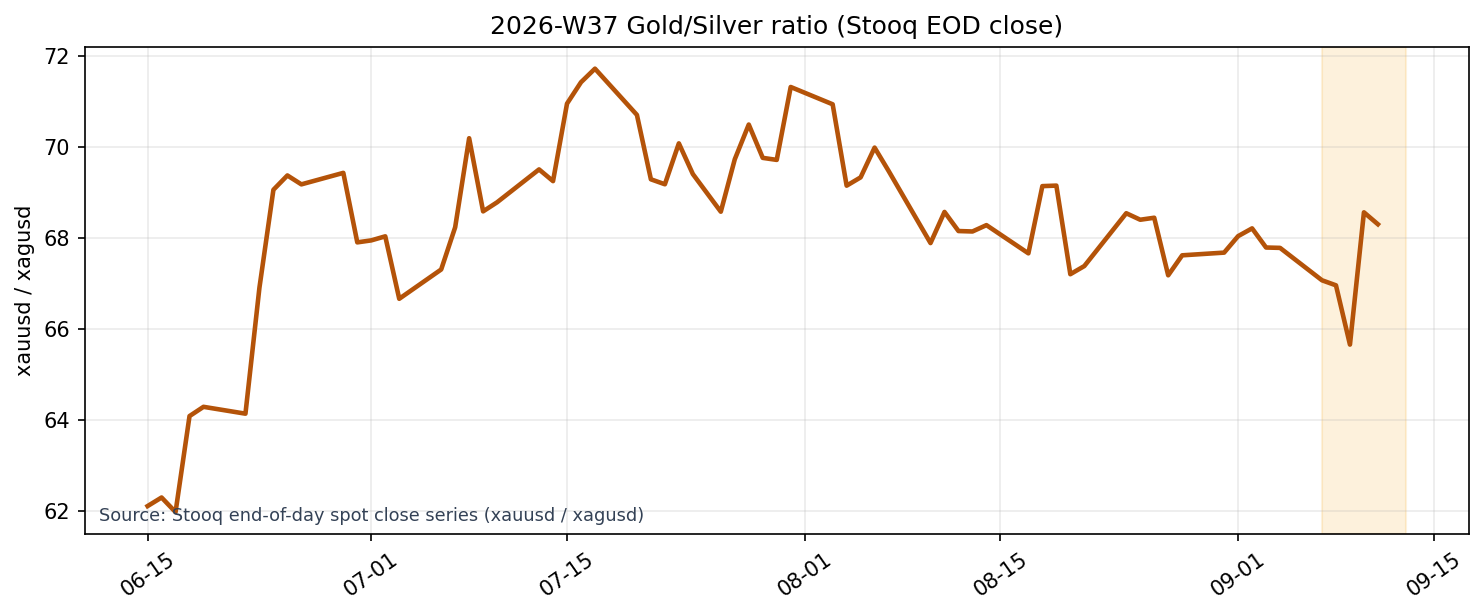
Source: Stooq end-of-day spot close series (xauusd / xagusd).
The spot prices in the figure above are based on EOD closing prices from the Stooq series. The gold-silver ratio was 68.2979, up +0.7655% from the previous week. While the gold price itself declined, it remained slightly stronger against silver. This indicates that defensive demand for gold remains, and that funds have not completely shifted to the more economically sensitive silver.
③ Investor Activity of Institutional Investors
CFTC COT (as of September 8) showed money managers holding long positions of 145,804 contracts, short positions of 10,832 contracts, and a net long position of 134,972 contracts. This represents a decrease of 1,799 contracts from the previous week. Given the simultaneous price rebound and position reduction, it is difficult to say that institutional investors significantly increased bullishness this week. However, the scale was not a sudden sell-off, and the depth of the net long position remains substantial, at 134,972 contracts against outstanding positions of 411,227.
Net positions are at the 82.69 percentile over the past year. Short-term buying positions have accumulated considerably, leaving limited room for profit-taking on negative factors. However, the position has decreased by 1,799 contracts from the previous week, suggesting a slight cooling of speculative fervor. Next week, whether the price rebounds and net long positions increase again will be key to gauging the sustainability of any recovery.
④ Macro Factors Check
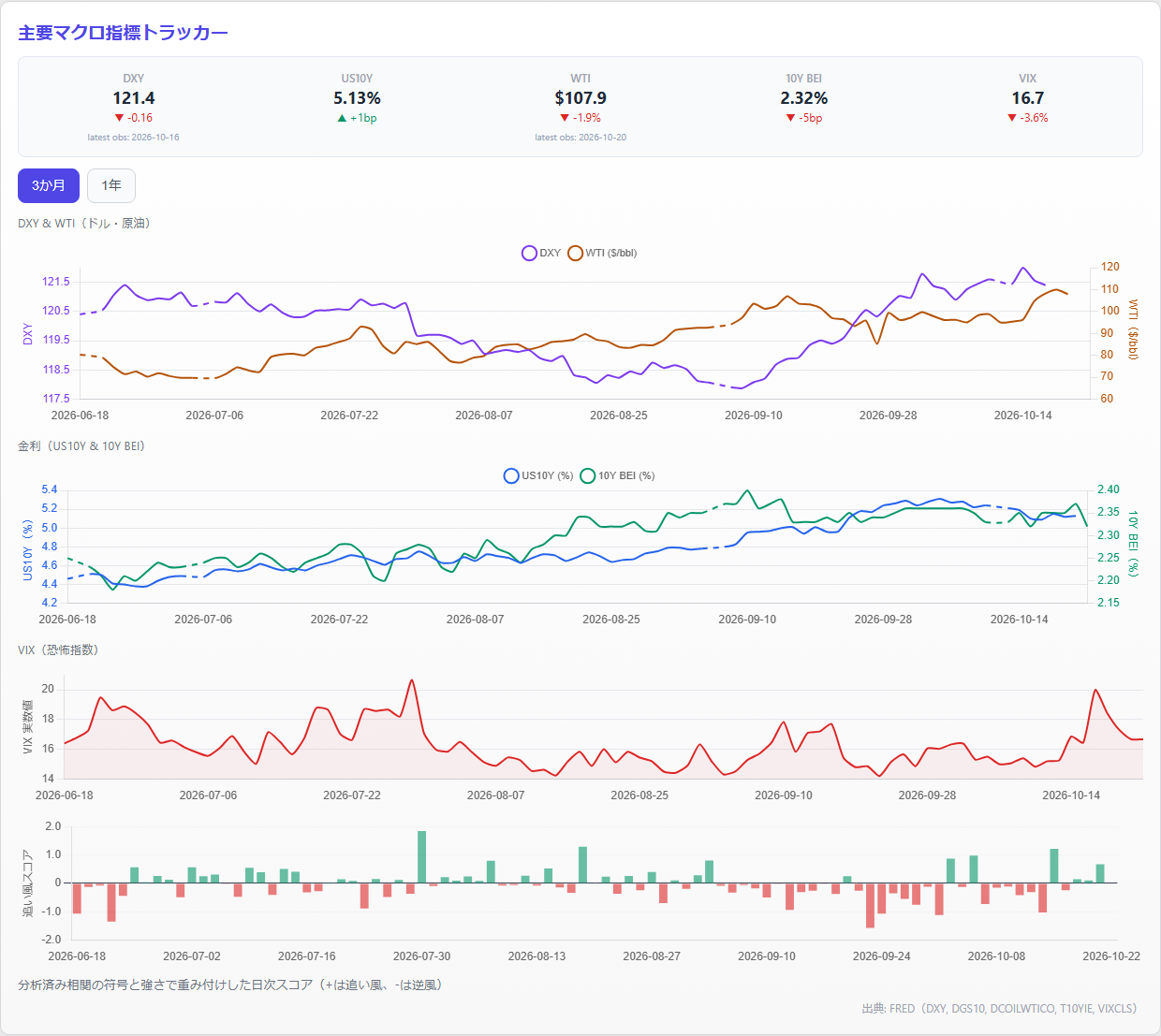
Macroeconomic conditions have become more challenging for gold. The DXY is at 118.2126, down -0.9246% compared to three months ago. The sustained dollar weakness remains supportive of gold. Conversely, the U.S. 10-year nominal interest rate is 4.96%, the breakeven is 2.36%, and the real interest rate proxy has risen to 2.60%. Real interest rates are up +20.9302% compared to three months ago, a clear headwind for gold, which does not generate interest.
The VIX is 15.84, and the HY OAS is 2.65%, indicating that there is not a strong sense of fear or credit risk in the financial markets. WTI is at $101.27, but has fallen 2.22% from the previous observation. Rather than a surge in demand for safe assets pushing gold prices higher, this week's decline appears to be the result of the weight of higher real interest rates outweighing a weaker dollar.
⑤ Supply and Demand and Sentiment
This week's gold-related articles totaled 27. Site-adjusted news sentiment averaged 0.6714 for the week, with a recent value of 0.91, both positive. It is interesting that the tone of articles improved during weeks when prices declined. This suggests a possible increase in materials positively evaluating buying opportunities rather than stemming from follow-up enthusiasm.
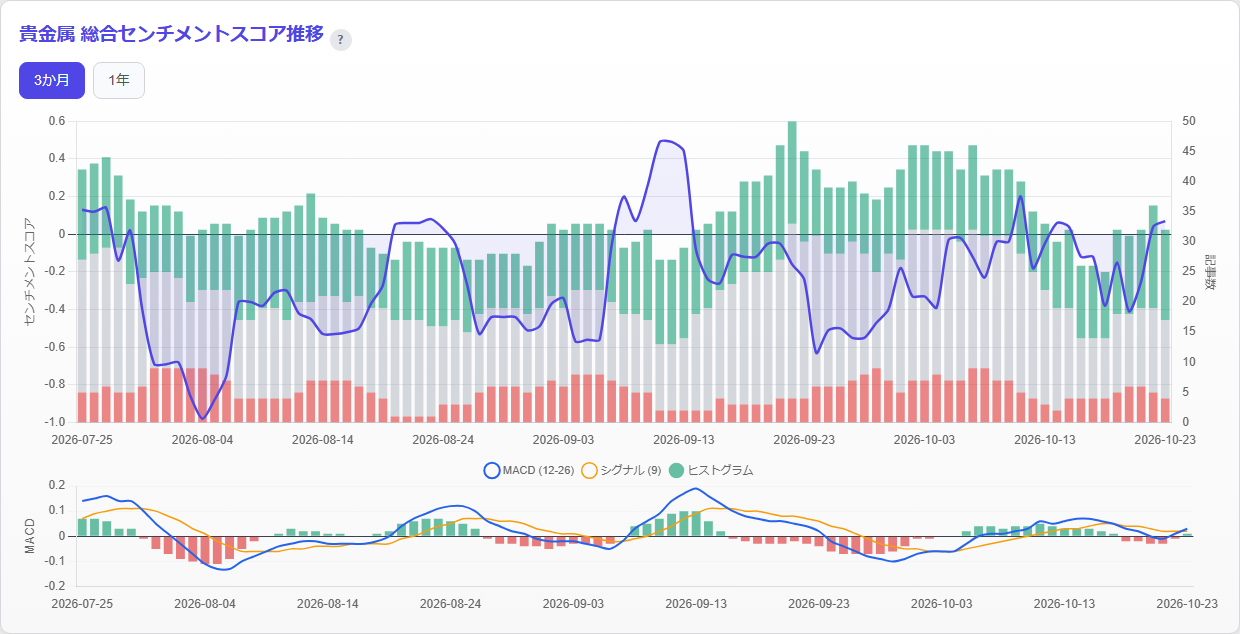
The Commitment of Traders (COT) report decreased by 1,799 contracts compared to the previous week, indicating that institutional investors have not yet accompanied sentiment improvement with additional buying. The direction in which this discrepancy resolves will be key. A shift in the COT report to an increase would support the sentiment improvement, while a continued decrease would suggest that positive news is leading without fundamental backing.
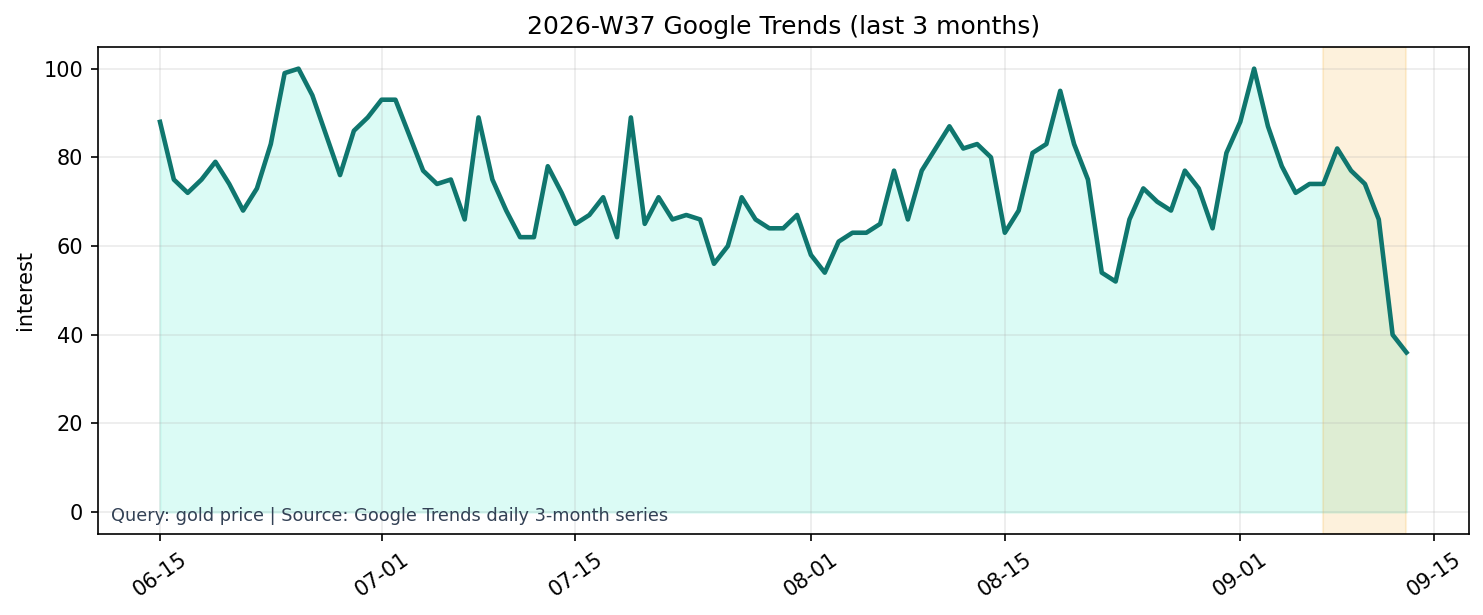
Source: Google Trends daily 3-month series (gold price).
Google Trends data for gold price shows the latest three-month series value at 36, a 10.0% decrease from the previous value of 40. The one-year series is at 24, a 22.5806% decrease from the prior week’s 31. The level of the one-year series is low, at the 1.89 percentile over the past year, indicating relatively weak general search interest. While news sentiment has strengthened, individual interest remains subdued, and market sentiment can be characterized as "improved, but not widely enthusiastic.
⑥ This Week's Insights and Next Week's Key Points
The core focus this week isn't the price decline itself, but the divergence of three indicators. The price fell -1.2896%, COT net longs decreased by 1,799 contracts, yet the adjusted sentiment improved to a weekly average of 0.6714. Moving forward, we will be assessing whether this psychological improvement translates into actual buying flow, or fizzles out in the face of high real interest rates.
Clear divergence is evident among indicators. The DXY is down 0.9246% compared to three months ago, leaving support for the dollar, while COT decreased by 1,799 contracts week-over-week. While news sentiment is positive, Google Trends data for the past year is down 22.5806% week-over-week. Therefore, the situation is not one where "interest and psychology follow price," but rather where strengthening in specialist news is preceding general interest.
Next week, we want to confirm three points in stages. First, can gold close above the $4,500 level? If it fails to do so, this week's decline may not be a mere consolidation but rather indicate resistance at the upper end. Second, will the real interest rate proxy move downwards from 2.60%? Even if the dollar weakens, rising real interest rates can easily suppress gold's rebound. Third, will the Commitment of Traders (COT) net long positions return to an increase, and will Google Trends show a reversal? If two or more of price, institutional flow, and individual interest align, we can view the improvement in adjusted sentiment as a leading signal.
Conversely, if rising real interest rates, a decline in COT (Commitment of Traders) data, and the failure to recover above $4,500 coincide, a bullish news cycle alone is not sufficient to trigger a rush to buy on dips. This week is about waiting for psychological improvements to translate into shifts in fund flows, rather than hastily categorizing the market as simply "bullish" or "bearish.