Gold prices are slightly lower, but improving sentiment indicates underlying strength.
① One-sentence summary for this week:
Gold fell 0.27% since the beginning of the week, but then rebounded from its low, with adjusted sentiment improving to a weekly average of 0.24 and 0.33 most recently. Speculative selling and high real interest rates were negative factors, while risk aversion supported the downside, resulting in a week of balanced strength and weakness.
② Price Trends and Chart Review
This week's gold futures series began at $4,220.80, closed at $4,209.30 as of October 16th, a 0.27% decrease from the beginning of the week. The high during the week was $4,242.30, and the low was $4,095.00. The trading range was $147.30, equivalent to 3.49% of the opening price. While the closing price was slightly lower, it briefly dipped below $4,100 before recovering over $110, indicating it was not a one-sided sell-off. The closing price is at the 76.86th percentile over the past 3 years; the 3-month return is +4.82%, and the 1-year return is -0.38%. Medium-term appreciation and annual sideways movement coexist.
20-day annualized volatility is 18.72%. The percentile ranking over the past 1 year is 16.41, while over the past 3 years it is 60.93, showing a significant difference. While the most recent 1 year has seen high volatility and currently appears calm in the short term, it cannot be described as entirely tranquil when viewed against a 3-year benchmark. Note that the spot price was based on futures series from yfinance, and the Spot and gold/silver ratio below are based on Stooq’s EOD series (xauusd / xagusd). Dates are based on the EOD label of each source.
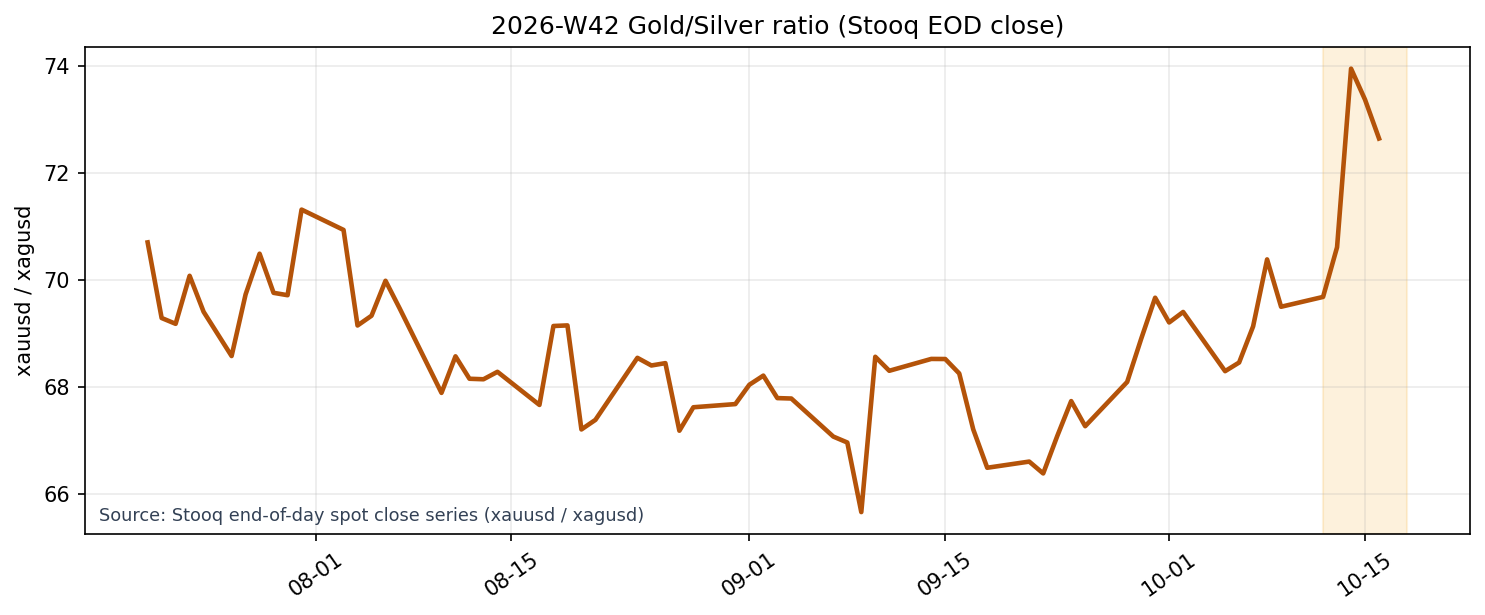
Source: Stooq end-of-day spot close series (xauusd / xagusd).
The gold-silver price ratio was 72.64, up +4.53% from the previous week. Gold was relatively stronger than silver. However, it is at the 29.31 percentile over the past 3 years, and has not broken out above the long-term range. Rather than attributing this week’s slight decline to “overall gold weakness,” it is more likely that defensive gold was favored within the precious metals sector.
③ Investor Activity
The CFTC COT report, as of October 6, showed money managers holding 127,101 long contracts, 16,114 short contracts, and a net long position of 110,987 contracts. This represents a decrease of 9,331 contracts from the previous week. While prices did not experience a major collapse, speculators reduced their long positions. This week’s stability was not due to increased buying by speculators, but rather was created by new leveraged buying.
Net positions are at the 49.02 percentile over the past 1 year, close to the median value. While not in a state where an unwinding of overheated long positions is the biggest risk, it is also difficult to say that institutional investors are tilting bullish and leading the uptrend. If prices can maintain the $4,100 level despite a continued decrease in the next COT report, it would indicate absorption by physical demand and safe-haven demand. Conversely, if a decrease in net long positions overlaps with a break below $4,095, we should be wary of a deterioration in supply and demand.
④ Macro Factors Check
The macroeconomic environment has not been a straightforward tailwind for gold. The DXY was at 121.60 as of October 9, a 0.13% increase from the previous observation. The US 10-year nominal interest rate was 5.19%. On the other hand, a proxy for US 10-year real interest rates was 2.84%, a 0.04 point decrease from the previous observation of 2.88%. Dollar strength has been a headwind, but the slight decline in real interest rates has marginally eased pressure on the cost of holdings.
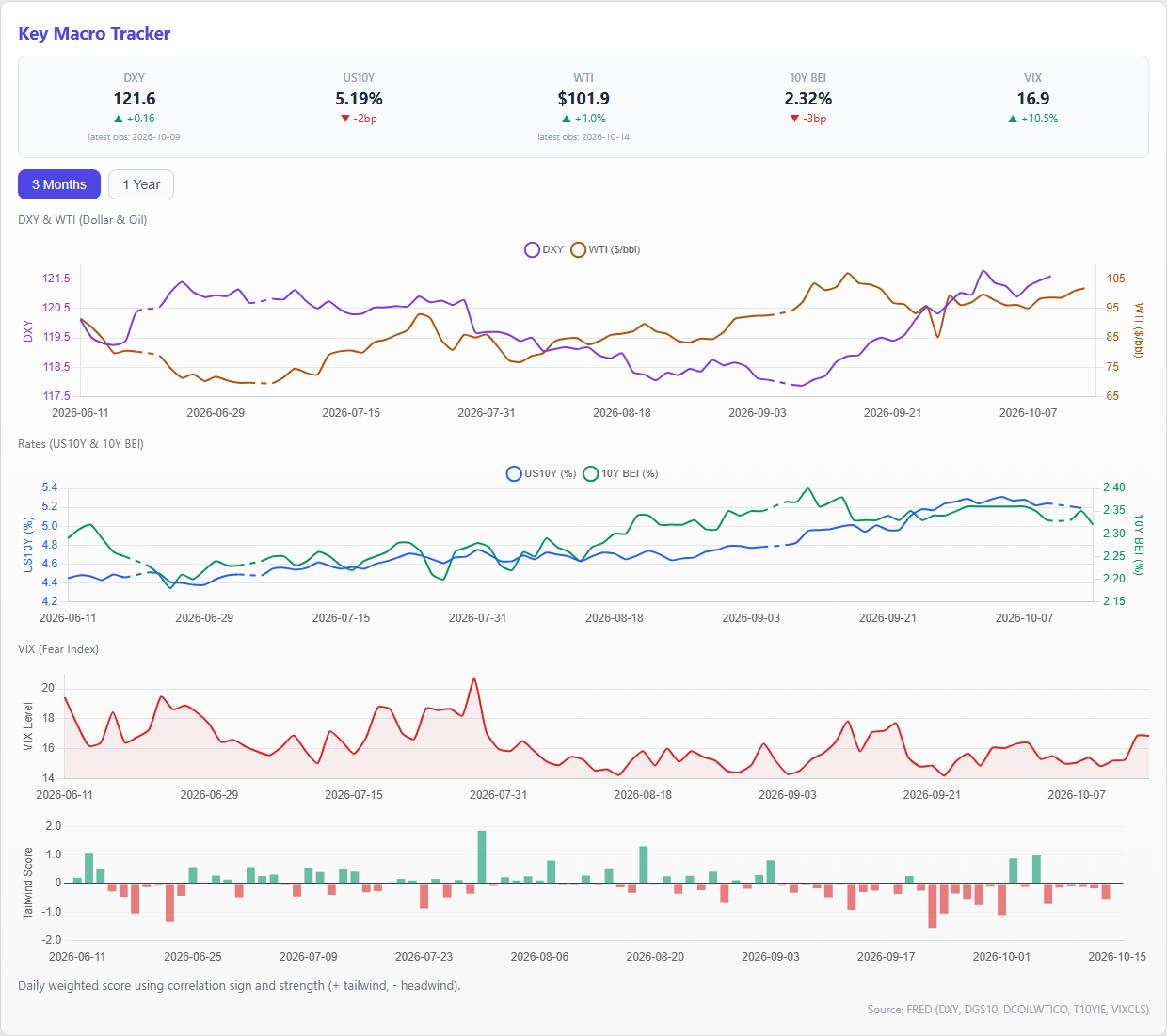
Simultaneously, the VIX rose to 16.87, a 10.48% increase from the previous observation, and the US high-yield bond OAS also expanded to 3.25%, a 0.09 point increase. Market tension is not of the acute crisis variety but supports gold as a safe haven asset. WTI is high at $101.91, and the breakeven inflation rate is 2.32%. Due to the coexistence of inflation concerns and high interest rates, we want to avoid a one-sided explanation of "gold prices will fall because interest rates are high" even next week.
⑤ Supply and Demand and Sentiment
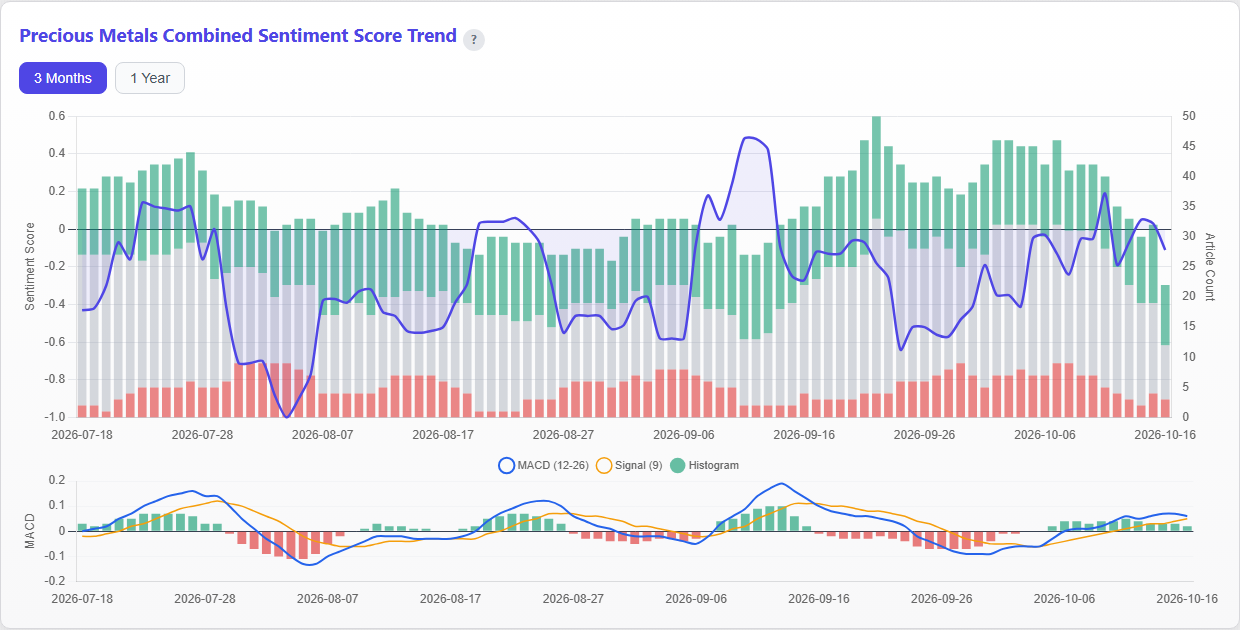
This week's gold-related articles numbered 23. Site-adjusted news sentiment was an average of 0.2425 for the week, reaching 0.33 most recently, a clear improvement from 0.09 at the start of the week. The average raw score based on articles was also positive at 0.4075, but the recovery in the main indicator, the site-adjusted sentiment, is more significant. While the price experienced a slight decline, the news tone has not worsened. Combined with the fact that net long positions in the COT report decreased by 9,331, this indicates a divergence – "speculators are cautious, but the underlying factors are not pessimistic.
Google Trends search terms were gold price. The 3-month daily series is the latest 50, up from 45 the previous day, but the 3-month change rate is -23.08%. The 1-year weekly series was 19, up from 18 the previous week (+5.56%), but remains at the 3.85 percentile over the past 1 year. Short-term search interest is recovering, but is far from widespread enthusiasm. Search demand is low relative to the price being near $4,200, and individual buying is not overheating the market.
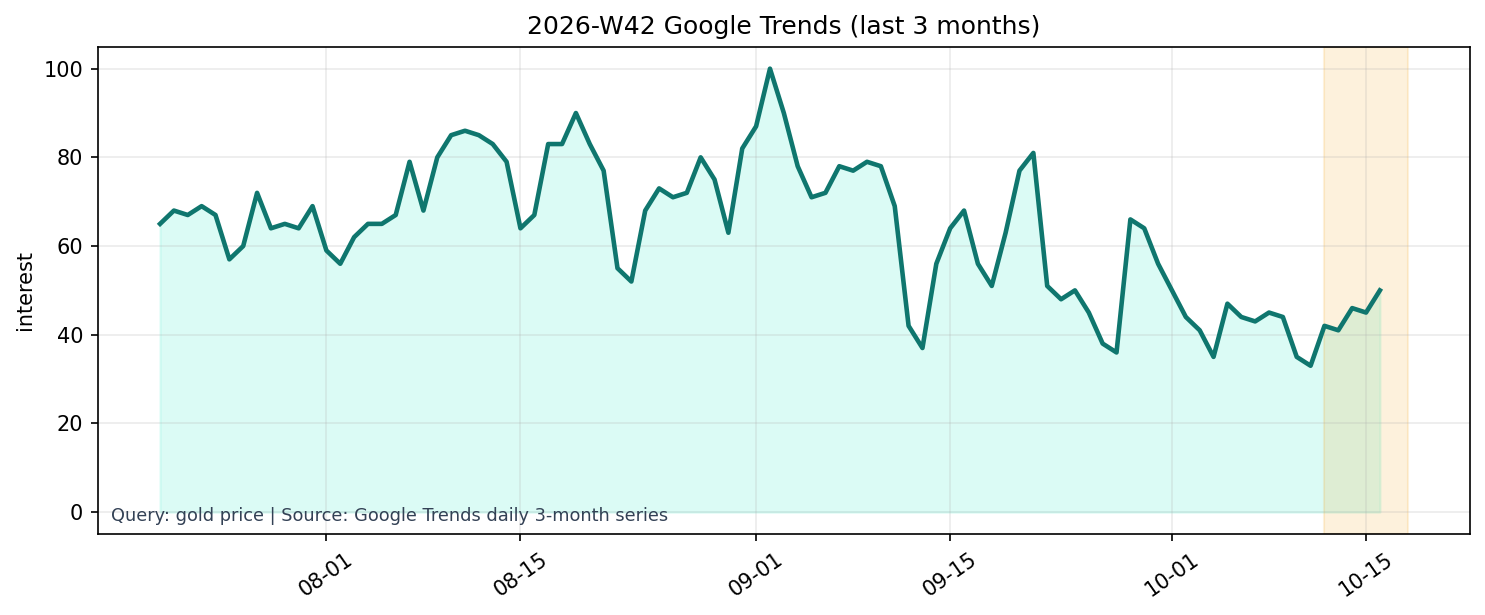
Source: Google Trends daily 3-month series (gold price).
⑥ This Week’s Insights and Next Week’s Key Points
This week's hypothesis is whether sentiment improvement and risk aversion demand can support the $4,100 level, even if speculative buying weakens. Gold fell 0.27% at the beginning of the week but recovered from its midweek low of $4,095 to a closing price of $4,209.30. COT data showed a decrease, the dollar is strong, and real interest rates are heavy at absolute levels. Nevertheless, the fact that the price did not break down suggests that bearish factors are likely already substantially priced in.
However, equating firmness with a resumption of the uptrend is premature. This report does not preserve observations or points from the previous week’s article; therefore, it will be the initial record rather than a confirmation of the continuation hypothesis. We would like to verify three conditions next week. First, whether the price can maintain 4,095ドル as a closing price and surpass this week’s high of 4,242.30ドル. A breakout would indicate buying on dips; a break below would suggest that this week’s rebound was temporary. Second, whether the next COT report will show a halt to the decrease in net long positions. If price increases and COT recovery align, it will strengthen the fundamentals of supply and demand.
Third, we examine the combination of real interest rate proxies and news sentiment. If the real interest rate falls from 2.84% and the adjusted sentiment remains in positive territory, a test above $4,242 is likely. Conversely, if the real interest rate rises again and sentiment falls below zero, we anticipate a retest of $4,095. Search interest is currently low, so even if prices rise, it will not immediately become a euphoric market. The key next week will be the price's resilience against selling pressure, rather than the abundance of buyers.