Gold Is Near Record Highs, Yet Still Not Overheated: Quiet Bullishness Backed by a Weaker Dollar and Lower Real Rates
① One-Sentence Summary This Week
The dollar's weakness and the decline in real interest rates supported a solid increase in gold prices over the week. However, speculative positions and news sentiment remain relatively restrained, suggesting a strong but not overheated market.
② Price Trends and Chart Review
This week's gold spot price, based on Stooq's closing values, rose from 5109.8 on 2026-02-23 to 5249.835 on 2026-02-27, resulting in a weekly gain of 2.7405%. The highest price during the week reached 5257.305, while the lowest was 5095.085, with a range of 162.22. The price reached 3.1747% higher compared to the opening price. Throughout the week, the price maintained a high level, and a pattern of buying back on dips continued.
Market volatility is significant. The 20-day moving volatility (annualized) has reached 40.2135%, a considerably high level corresponding to the 97.41 percentile over the past three years. The market's fluctuations, with upward price action, suggest a strong momentum. Over the past three months, it has risen by 24.0651%, and by 83.8857% over the past year, maintaining a market tone that encourages buying on dips.
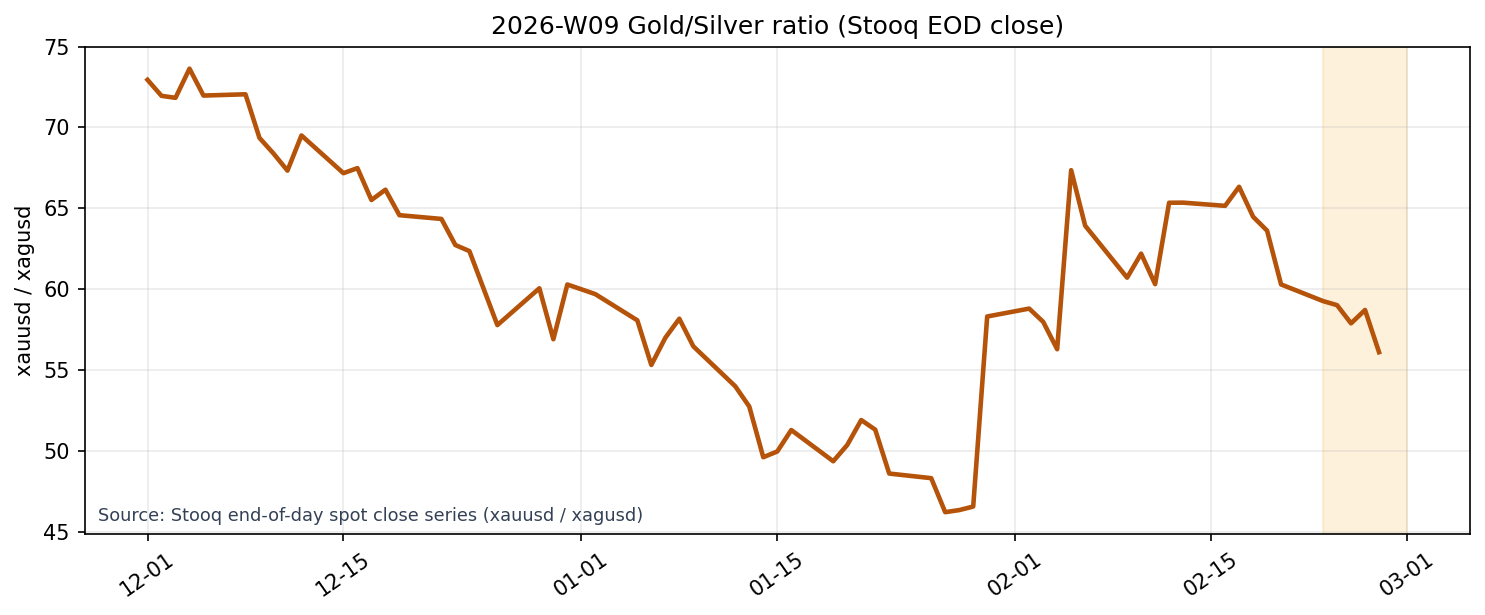
Source: Stooq end-of-day spot close series (xauusd / xagusd).
Looking at relative valuations against other assets, the gold-silver ratio is at a low level of 56.2979, suggesting a continued environment where funds are flowing into precious metals, including silver. On the other hand, the gold-oil ratio is 78.7764, an extremely high level in the top 98.25 percentile over the past three years. This indicates that gold is being significantly outperforming oil in terms of real economic energy prices.
③ Investor Activity of Institutional Investors
The latest CFTC COT report, as of February 17, 2026, showed that money managers' net long positions increased by 3871 to 95893. The combination of 123011 longs, 27118 shorts, and 407078 open interest indicates that the net long position is continuing. However, the level has stabilized considerably. The net position currently sits at the 27.1 percentile over the past three years, suggesting that futures positions have not yet fully expanded despite prices being in a high range.
This divergence is significant. The accumulation of speculators relative to price strength suggests that funds are lagging and following, rather than a market heavily skewed towards long positions. If the Commitment of Traders (COT) catches up to the price increase in the coming week, the trend is likely to be sustainable. Conversely, if prices lead alone and net longs do not increase, volatility is likely to widen further, driven by physical and ETF flows. For reference, the 60-day beta against QQQ is 0.5408, and the 252-day beta is 0.0474, indicating that while short-term movements tend to correlate with the stock, it is often treated as a diversification asset in the medium to long term.
④ Macro Factors Check
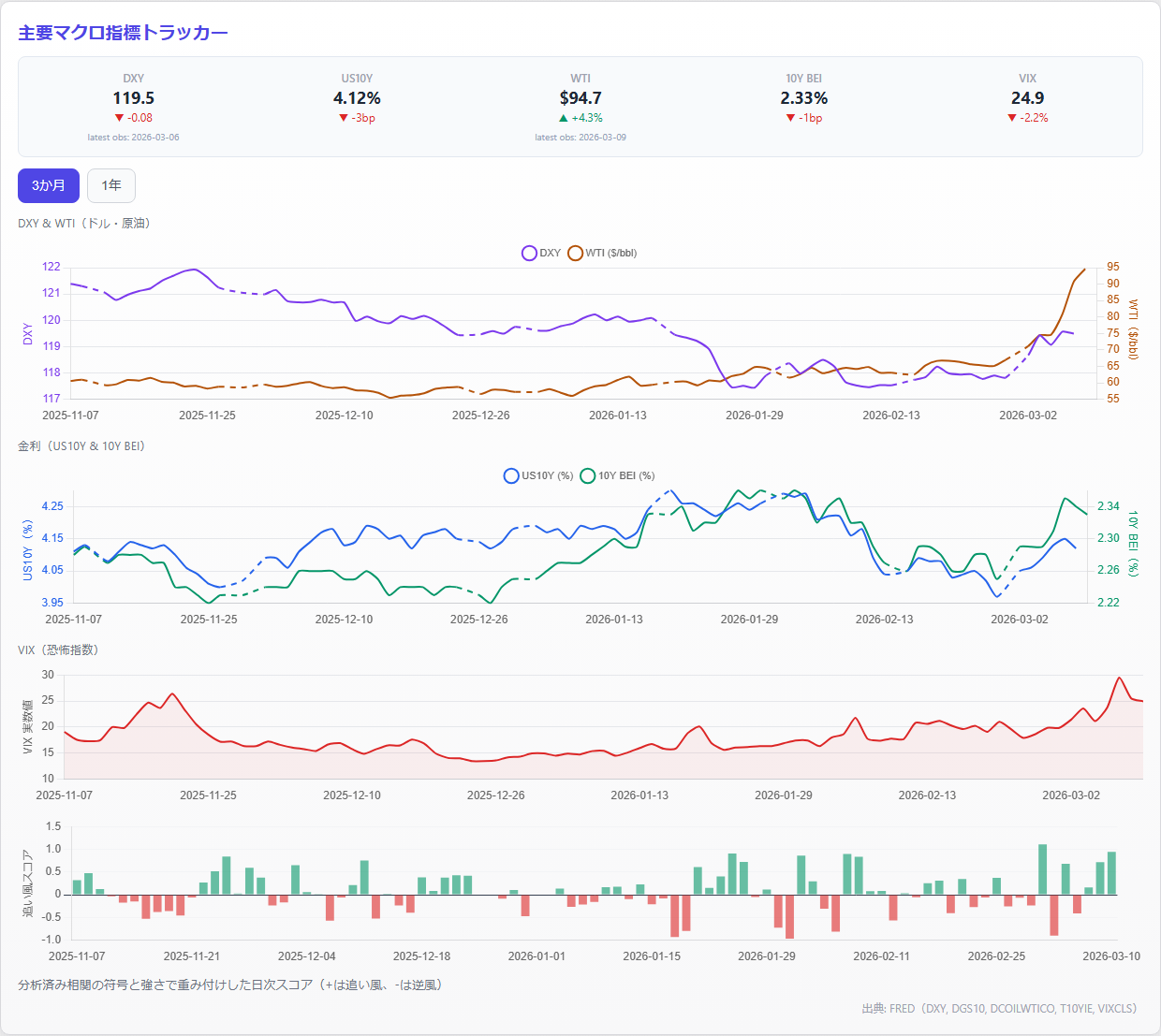
The macroeconomic tailwinds are quite clear. The DXY is at 117.9917, down 2.4751% over three months and 8.0205% year-on-year, which is generally favorable for gold priced in dollars. U.S. 10-year Treasury yields are at 4.05%, and the real interest rate proxy is at 1.77%, a low level for real rates that is consistent with this week’s price increase for gold. The 10-year BEI, reflecting expected inflation, is at 2.28%, positioned more moderately than extreme inflation reacceleration.
On the other hand, the market is not solely driven by a sense of security. The VIX has risen to 18.63, indicating that caution remains in the stock market. Top topics include concerns about AI proliferation impacting US stocks and the US-Iran conflict, and the narrative of risk aversion has not yet dissipated. The buying of gold is best understood not as a resurgence of inflation, but rather as a combination of a weaker dollar, declining real interest rates, and risk aversion.
⑤ Supply and Demand and Sentiment
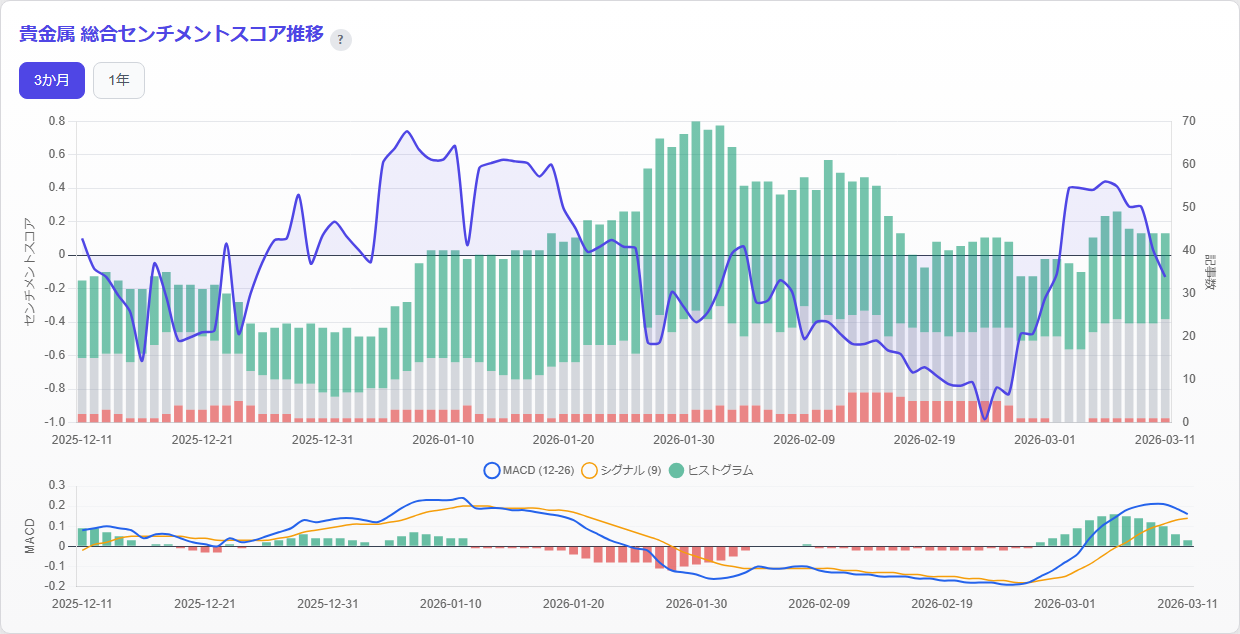
This week's gold-related articles numbered 30. Top tags were finance, corporations, supply and demand, investment flows, and policy, with the theme focused on shifts in capital flows and supply/demand changes rather than price itself. The news sentiment score was positive at an average raw score of 1.3033, but the week-average of the adjusted sentiment used as a primary indicator was -0.602, and the latest value remains in negative territory at -0.31. It's more accurate to describe this as a cautious sentiment rather than outright pessimism; the excitement level has not yet reached an overheated state when considering the deviation from the long-term average. Sentiment deteriorated to -0.83 on February 24, but recovered to -0.31 by February 27, indicating improvement, though still far from exuberance.
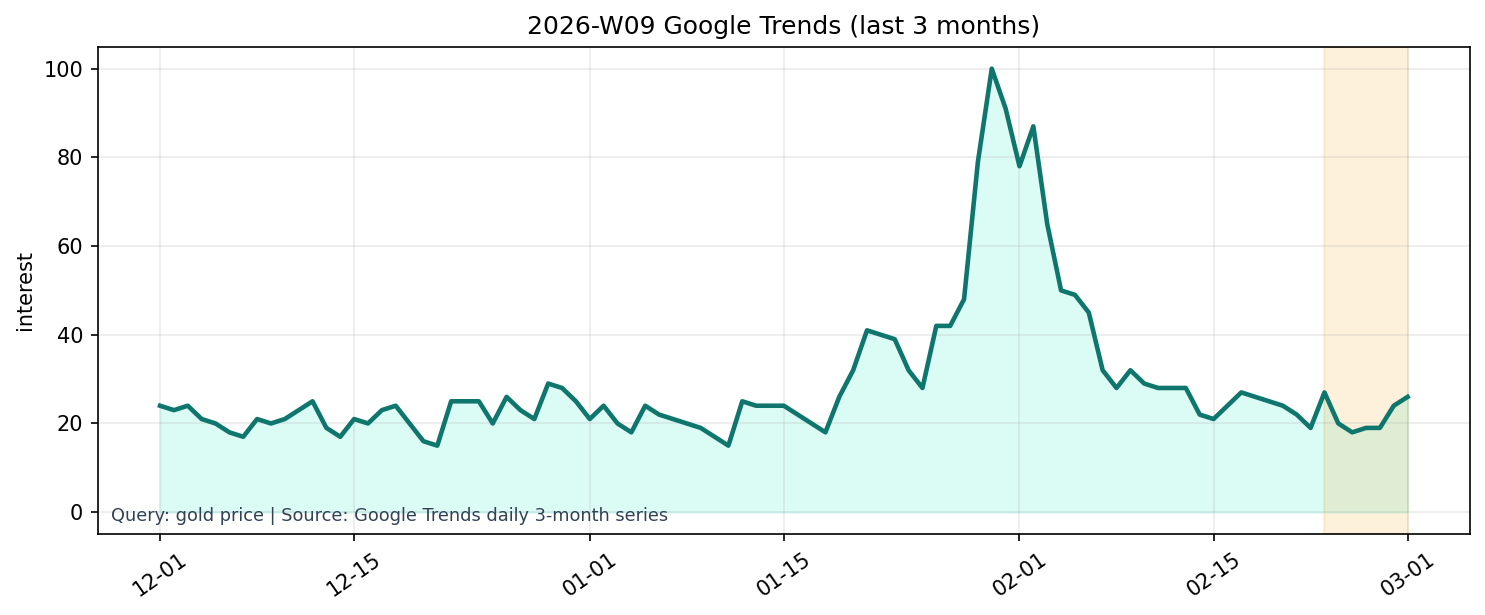
Source: Google Trends daily 3-month series (gold price).
On the supply and demand side, news of a nearly 69% increase in China’s January Hong Kong-via net imports provided support for underlying physical demand. Google Trends indicates a steady rise in interest rather than a sudden spike. The latest one-year value for the search term gold price is 31, which is 93.75% higher year-on-year, while the level is in the mid-range of the past year’s 46.15 percentile. Individual investor interest is higher than last year, but it is not yet indicative of a fervent boom.
⑥ This Week’s Insights and Next Week’s Key Points
The most interesting aspect of gold this week is that "prices are strong, but positions and sentiment are not yet fervent." Prices are in a high range, while Commitment of Traders (COT) net longs are at or below the lower-middle range when looking back over the past three years, and the adjusted sentiment weekly average remains at -0.602. This is closer to a situation where prices are leading, driven by macro factors, and participants' conviction has yet to catch up, rather than the end of a bubble. A strong market, but not euphoric.
Here are three key points to watch next week. First, the dollar and real interest rates. If the DXY continues to decline and the real interest rate proxy remains low at 1.77%, the upward trend for gold is likely to be sustained. Second, observe the Commitment of Traders (COT) report. A clear build-up of net long positions to 95,893 would confirm follow-through from institutional investors. Conversely, if this build-up doesn't occur, the price increase will likely be fragile and susceptible to downward pressure. Third, monitor public interest. If the Google Trends 1-year series continues to rise and the latest sentiment indicator recovers from -0.31 towards zero, there's a possibility that market leadership will shift from macro hedging to broader investment flows. Conditionally, as long as the price remains above the week's opening level of 5109.8 and the gold/crude oil ratio remains elevated, gold is likely to be favored as a "defensive buy" next week.
(Please also refer to metalsvision.com for detailed data and the latest chart analysis related to this report.)