Gold Can Stay Bullish Even Through a Pullback: The Next Move Backed by a Weaker Dollar, Low Real Rates, and Strong Interest
① One-Sentence Summary This Week
Gold declined on a weekly basis, but the move felt more like an adjustment within a high-price range than a breakdown. A weaker dollar and low real interest rates continue to be supportive factors, and institutional positioning remains far from overheated. Short-term volatility has been significant, but the medium-term bullish structure is still in place.
② Price Trends and Chart Review
This week's gold spot price, based on Stooq's closing values, decreased from 5312.56 on 2026-03-02 to 5166.145 on 2026-03-06, resulting in a weekly change of -2.7560%. The highest price during the week was 5418.765, the lowest was 4997.975, with a range of 420.79, and reached 7.9207% compared to the opening price. While the closing price was below the week's opening level, it has recovered significantly from the low, suggesting a week of adjustment with sharp fluctuations rather than a unidirectional decline.
Market volatility remains undeniable. The 20-day moving volatility (annualized) is 31.1957%, placing it at the 94.18 percentile over the past three years. The market is trading in a high range while exhibiting significant price fluctuations, suggesting a continuation of characteristic whipsaws rather than a trend reversal. Indeed, the closing price level itself remains relatively high, at the 99.09 percentile over the past three years. The three-month return is 23.2847%, and the one-year return is 77.5698%, making this week’s decline easily interpretable as a pullback within a longer-term uptrend.
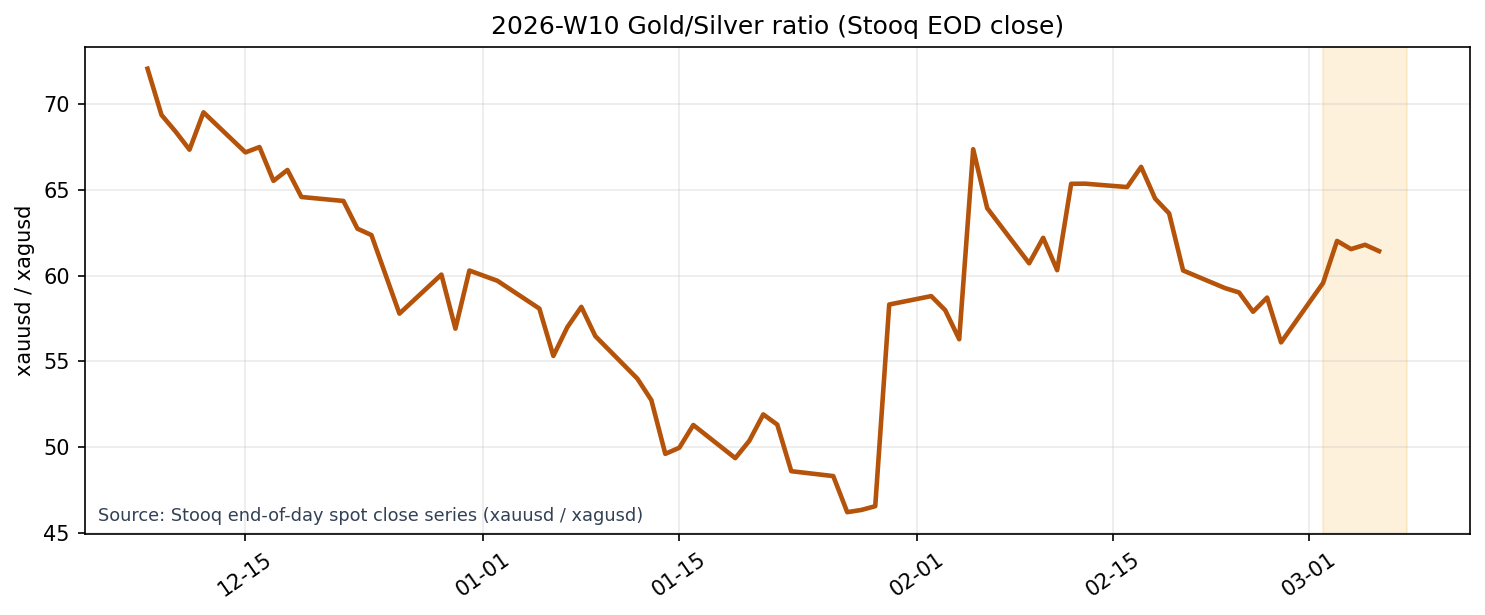
Source: Stooq end-of-day spot close series (xauusd / xagusd).
It is also important to consider relative valuations compared to other assets. The gold-silver ratio is 61.4230, placing it in the 4.92 percentile over the past three years – a low level. It increased by 9.4775% week-over-week, indicating that gold has been relatively stronger than silver. Conversely, the gold-oil ratio is 74.8231, in the 93.12 percentile over the past three years. While it decreased by 4.8192% week-over-week, it remains at a high level, suggesting that gold’s valuation has not significantly deteriorated despite rising energy prices.
③ Investor Activity of Institutional Investors
The latest CFTC COT report, as of March 3, 2026, showed that money managers' net long positions increased by 1943 to 97917. The combination of 123456 longs, 25539 shorts, and 409789 open interest indicates a slight accumulation of a bullish bias. However, levels are still far from overheated. The net position remains at the 27.56 percentile over the past three years, suggesting that the futures-driven bullish positions have not expanded significantly despite prices being in a high range.
This point is important. The fact that prices are high despite a lack of extreme speculative positioning suggests that the market hasn't been created solely by a buying surge, but also leaves room for further follow-through from institutional investors. Looking at short-term equity correlation, the 60-day beta to QQQ is 0.5408, with a correlation of 0.2250, indicating a tendency to be pulled by fluctuations in risk assets. However, the 252-day beta is a relatively low 0.0474, suggesting it remains attractive as a diversifier in the medium to long term.
④ Macro Factors Check
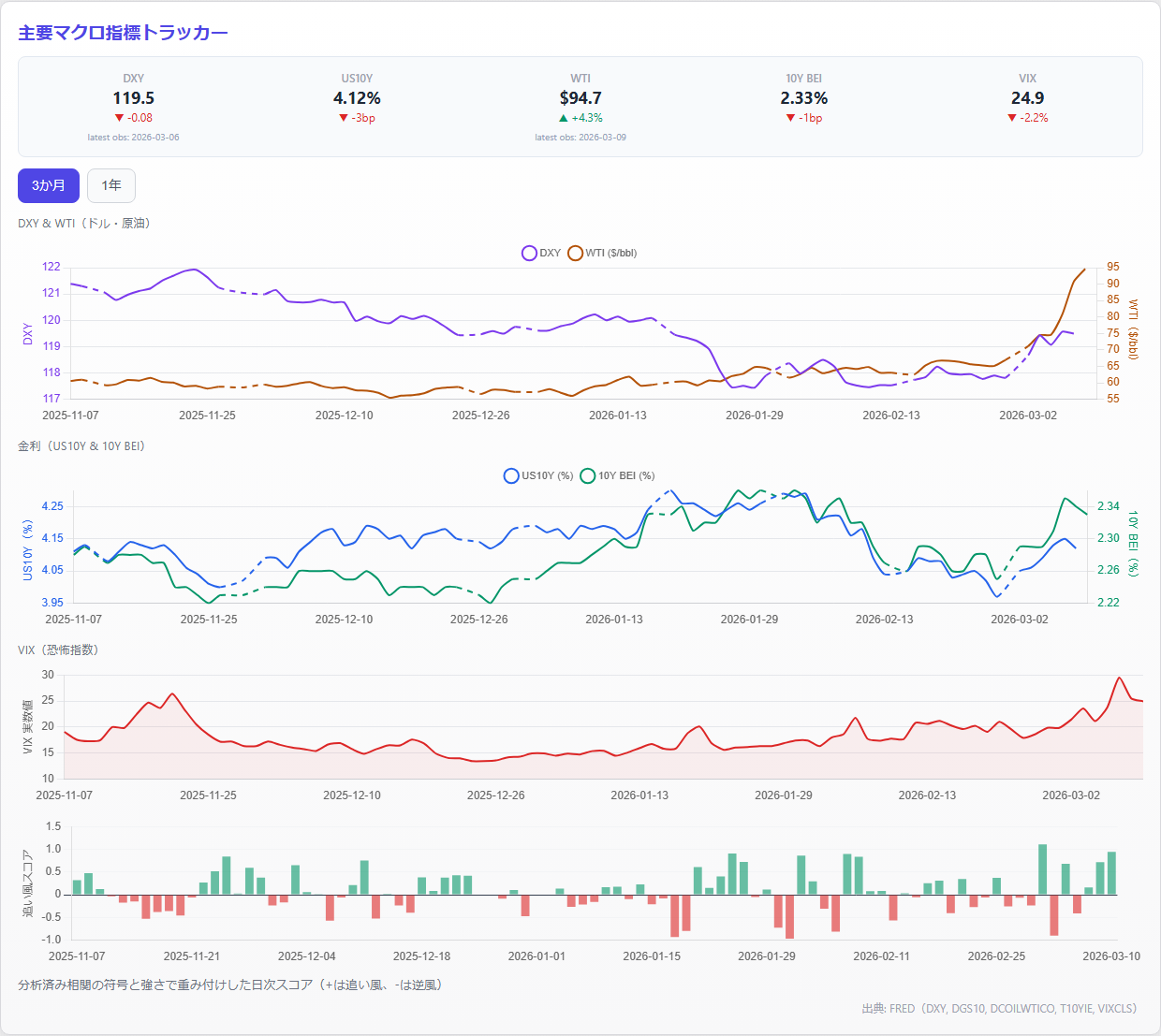
The macroeconomic environment remains generally unfavorable to gold. The DXY is at 117.8223, down 2.4456% over three months. The real interest rate proxy is low at 1.80%, and has also decreased by 5.7592% over three months, which continues to be a tailwind for gold's holding costs. U.S. 10-year nominal interest rates have risen slightly to 4.09%, but the 10-year BEI, indicating expected inflation, has also rebounded to 2.31%, meaning nominal interest rates are not rising in isolation.
This week was particularly notable for the rise in the VIX and higher oil prices. The VIX reached 23.75, placing it in the 94.82 percentile over the past three years – a significantly high level. Uncertainty remains strong, and demand for gold as a safe haven persists. Meanwhile, WTI rose to $71.13, a 20.4776% increase over three months. The market is simultaneously experiencing a resurgence of inflation concerns and economic uncertainty, making this week one where supporting factors and profit-taking pressures competed for gold.
⑤ Supply and Demand and Sentiment
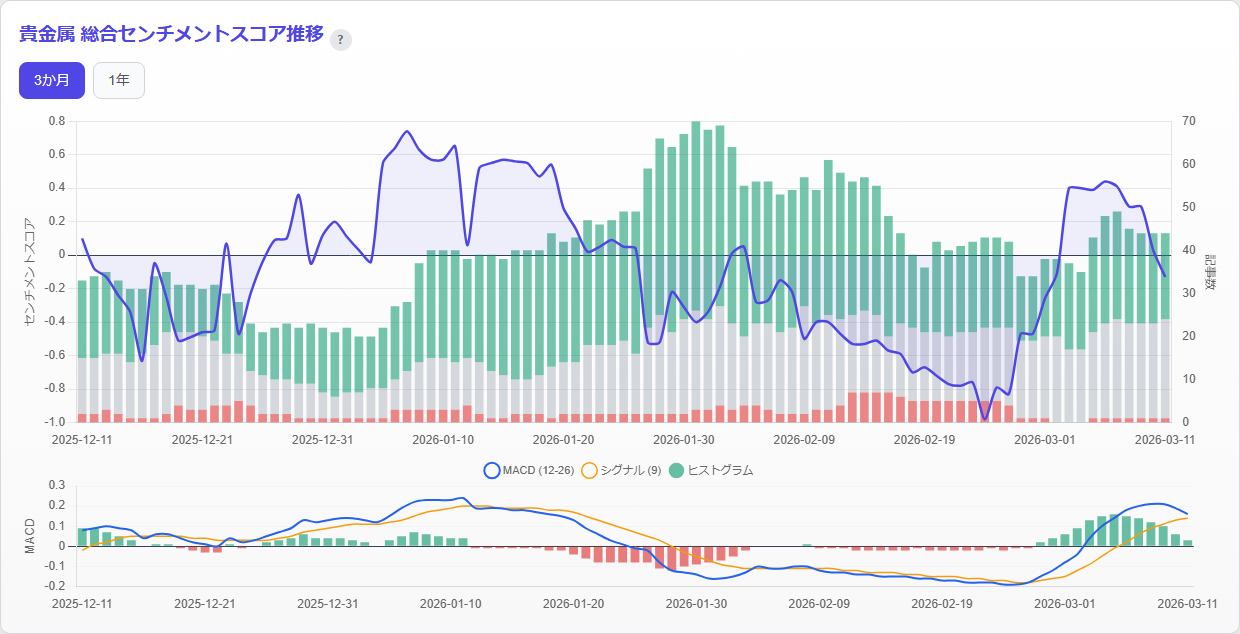
This week's gold-related articles numbered 39. Top tags were finance, corporations, investment flows, policy, and geopolitics, with the focus being on the interpretation of fund movements and policy/geopolitical events rather than prices themselves. Individual topics included concerns about U.S. stock risk-off due to the spread of AI, reports of Trafigura's purchase of gold from Venezuela, a decrease in sales at the Perth Mint, and the issue of royalty increases in Ghana. The week saw a mix of supply, policy, and flight-to-safety demand factors.
News sentiment scores have improved considerably. The weekly average of the adjusted sentiment indicator, used as a primary metric, is 0.486, and the latest value is 0.55, moving into positive territory and clearly recovering from last week’s negative range. It rose to 0.58 on March 3 and 0.64 on March 5, indicating that the news flow was not as weak as the weekly price decline. This suggests a discrepancy: while price movements have been adjustments, the content of articles has remained generally bullish. This demonstrates that fundamental interpretations have not yet broken down in response to short-term price adjustments.
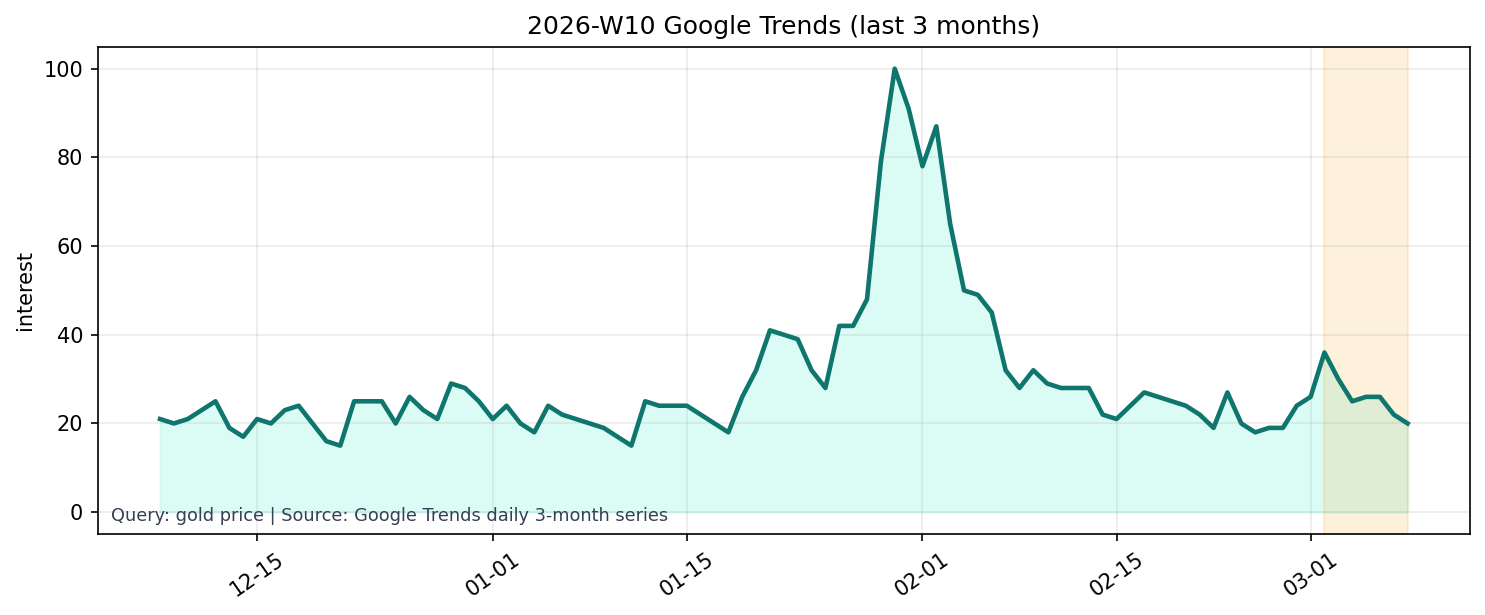
Source: Google Trends daily 3-month series (gold price).
Individual investor interest remains firm. Google Trends search term data for gold price shows a 3-month series latest value of 27 and a 1-year series latest value of 46. The 1-year series has increased by 48.3871% week-over-week, with levels in the 87.04 percentile over the past 3 years – a high level. While not yet at a peak of fervent interest, interest is clearly increasing. The fact that search demand has not decreased even after a price consolidation suggests a favorable foundation for funds to re-enter during pullbacks.
⑥ This Week’s Insights and Next Week’s Key Points
In a nutshell, this week for gold has been characterized by a correction within a high-price range, but bullish factors remain. While the price decreased by -2.76% on a weekly basis, the adjusted news sentiment remained positive, averaging 0.486 for the week and reaching a latest value of 0.55. The Commitment of Traders (COT) net long position also increased slightly to 97917, indicating neither overheating nor a complete exit by speculators. Despite appearing to have weak price action, surrounding data has not collapsed.
First, let's review last week's "Three Things to Watch." Firstly, regarding the DXY and real interest rates, the tailwinds of a weaker dollar and low real interest rates were maintained this week as well. Nevertheless, prices declined on a weekly basis, indicating that even these macro tailwinds were not enough to absorb profit-taking selling this time. This confirms that the gold price uptrend remains intact, but that short-term position adjustments also cannot be ignored. Secondly, concerning the VIX and reconnection with gold buying, the VIX rose to 23.75, but this increase in fear did not translate directly into a rise in gold prices. Risk aversion was present, but it did not entirely flow into gold, suggesting a slight disconnect between "rising anxiety" and "gold buying" this week. Thirdly, regarding the combination of Google Trends and news sentiment, this area remained relatively stable. Search demand remained at high levels, and adjusted sentiment remained in positive territory, suggesting that the narrative among market participants has not been broken, even as prices paused.
Looking ahead to next week, we should incorporate the above three points, along with the Middle East situation, particularly military tensions between Iran and the U.S., as clear observation items. Geopolitical risk has been a backdrop to this week’s news flow. Should the conflict between the U.S. and Iran deepen, manifesting as additional sanctions, limited military clashes, shipping route risks, or concerns about crude oil supply, we could see a simultaneous impact on gold through higher oil prices, a VIX increase, and increased demand for safe-haven assets. Conversely, if tensions ease and diplomatic efforts to de-escalate progress, the current pattern of “favorable macroeconomic conditions but price adjustments” is likely to continue.
Therefore, there are four points to watch next week. First, DXY and real interest rates. If the dollar weakens and real interest rates decline, this week's decline is likely to be absorbed as a buying opportunity. Second, whether the high VIX will actually reconnect to gold buying. If the stock market continues to adjust, and geopolitical instability underlies that adjustment, a preference for safe assets is likely to become even more prominent than it was this week. Third, the combination of Google Trends and news sentiment. If search demand remains stagnant and adjusted sentiment remains around 0.5, the market participants' narrative will not yet be broken, even if prices decline. Fourth, the quality of news regarding Iran and the United States. The extent of the impact on gold will vary considerably depending on whether it is merely a warning statement, or involves practical sanctions tightening or military action risk. Conditionally speaking, if the four points of a weak dollar, low real interest rates, high VIX, and Middle East tensions remain simultaneously, this week's adjustment is likely to be interpreted again as a buying opportunity. Conversely, be aware of the risk that the adjustment in the high price range may deepen further if sentiment dulls and Middle East risk recedes.