Gold Prices Rebound Without Euphoria: How to Read a Softer Dollar and Retreating COT Positioning
① One-Week Summary
Gold modestly rebounded, rising +0.27% for the week in 2026-W22, but the upward movement wasn't entirely bullish. While the dollar was weak, speculative positions (as indicated by the COT report) decreased, and news-adjusted sentiment again fell into negative territory. Prices remained resilient, suggesting a week where supply and demand remain relatively balanced.
② Price Trends and Chart Review
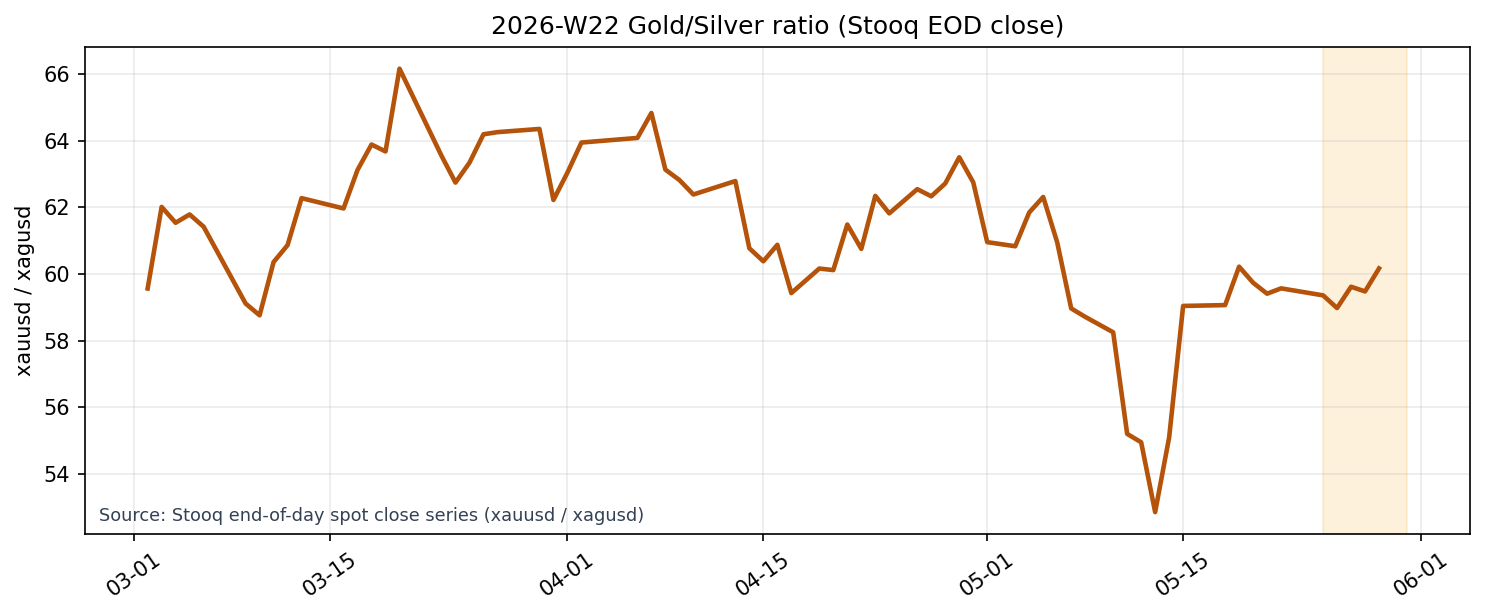
*Source: Stooq end-of-day spot close series (xauusd / xagusd).
Price charts refer to Stooq spot closing prices. In the weekly_inputs weekly snapshots, gold began at $4,532.0 on May 25, 2026, and closed at $4,544.3 on May 29, representing a +0.27% change from the prior week. While a halt to the previous week’s -0.78% decline is confirmed, it was not a particularly strong week of recovery. The weekly high was $4,582.6, the low was $4,363.5, the range was $219.1, and the change from the opening price was +4.83%. The price action was more volatile than it appears, and it seems more natural to interpret it as continued, rough price consolidation rather than a recovery trend.
The annualized volatility for 20 years was 17.37%, slightly down from 18.71% the previous week. The 3-year percentile is at a moderate-to-high level of 66.15, but not indicative of panic-driven fluctuations. The closing price level is at the 88.93 percentile over 3 years, still within a high range. On the other hand, the 3-month return is -14.62%, while the 1-year return is +37.92%, indicating simultaneous short-term adjustment and long-term appreciation. This suggests the trend has not broken, but rather is experiencing a speed adjustment while maintaining a high level.
In terms of ratios, the gold-silver ratio was 60.17, up +1.01% from the previous week. However, the 3-year percentile remains quite low at 7.08, suggesting that silver’s strength persists over a longer timeframe. Regarding W21 ("4,500-dollar range maintenance"), the focus was on whether it could be sustained. This week, the price was pushed down to 4,363.5 during the week, but recovered to 4,544.3 by the weekend. The fact that it tested the low and still held the closing price can be evaluated as indicating that at least one direction of breakdown did not occur.
③ Investor Activity of Institutional Investors
As of May 19, the CFTC'sマネーマネージャー・ネット (Money Manager Net) position was 93,540 contracts, a decrease of 4,475 contracts from the previous week's 98,015 on May 12. Last week, despite weak prices, the increase in the COT (Commitment of Traders) report confirmed continued buying on dips. However, this week, that trend has receded. Given that speculative positions decreased during a week of slight price recovery, we should interpret this as "speculators are not yet actively participating in the price rebound.
The COT levels remain only at the 3-year percentile of 25.81. This isn't a correction of overheating, but rather a further reduction in positions that weren't particularly crowded to begin with. This suggests a tendency for short-term price ceilings to be lacking, but the progress in position adjustment leaves room for a potential medium-term reacceleration. The fact that the 60-day beta is only 0.54 and the 252-day beta is 0.05 indicates that gold is still treated as a diversifier rather than a substitute for risk assets.
Last week’s report highlighted whether Commitment of Traders (COT) would exceed 100,000 contracts as a key point to watch; however, the actual result was in the opposite direction. This indicator proved inaccurate. However, the nature of this deviation is important – it wasn't a full-blown exodus by speculators, but rather a situation where participation remained sluggish relative to the high price levels. A strong resumption of the upward trend requires new buying to follow, but conversely, it also suggests that the market isn't currently overheated, and therefore, upward potential hasn't been exhausted.
④ Macro Factors Check
Last week, the key observation was regarding real interest rates. This week, the U.S. 10-year nominal interest rate is 4.48%, the 10-year breakeven is 2.39%, and the resulting real interest rate proxy is 2.09%. This is a slight decrease from W21’s 2.13%, which represents a modest improvement for gold. In response to last week’s question regarding whether the rise in real interest rates would stop, the answer is, “Not a complete tailwind, but the deterioration has paused.”
The dollar index DXY is at 119.29, with a 3-month change of +0.52% but a 1-year change of -2.04%. The 3-year percentile is also low at 13.83, suggesting that the dollar remains structurally under pressure. The VIX is 16.29, and high-yield OAS is 2.71%, neither indicating credit concerns or strong risk-off sentiment. WTI is at $97.63, a high level at the 95.42 percentile for 3 years, but has stabilized from $112.25 for W21. This week's gold can be characterized not as having been "bought up during a crisis," but rather as having "found support as the dollar's weight eased and the deterioration of real interest rates stopped.
⑤ Supply and Demand and Sentiment
Supply and demand, and sentiment, are somewhat subdued compared to the firmness in prices. This week's gold-related articles totaled 30, an increase from 26 the previous week, but the week's average sentiment after site correction was -0.288, with the most recent value at -0.30. W21 was +0.044 for the weekly average and +0.02 most recently, indicating that sentiment has deteriorated again. The raw score average was 0.716, exceeding the previous week's 0.554, suggesting that the content of the articles themselves exists, but the corrected tone appears to be cautiously inclined. In other words, the volume of discussion has returned, but a bullish conviction has not.
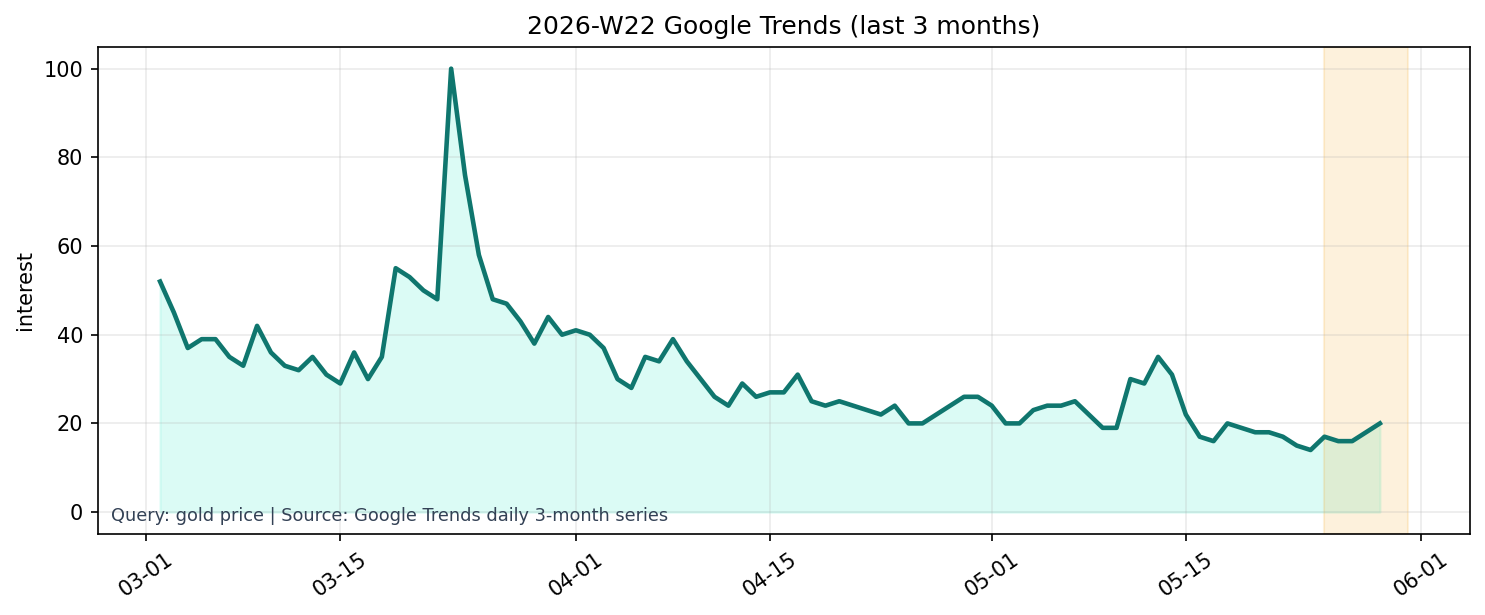
Source: Google Trends daily 3-month series (gold price).
Google Trends data for gold price showed a recent three-month value of 20, up +11.11% from the previous week. The one-year series was 22, down -4.35% week-over-week. However, the one-year percentile remains at 17.31, indicating relatively low search demand. Despite the price being at a high three-year percentile of 88.93, search interest has not increased. This discrepancy continued this week. Light Commitment of Traders (COT) data, low search demand, and a corrected sentiment score indicating a negative outlook suggest a cautious holding phase rather than speculative overheating. While the supply and demand picture indicates a lack of fuel for further price increases, it also suggests a limited risk of a sharp correction.
⑥ This Week's Insights and Next Week's Key Points
Last week (W21) focused on three key points: whether real interest rates would continue to rise, whether prices would retest the low of around $4,465, and whether the Commitment of Traders (COT) report would exceed 100,000 contracts. The answers were mixed. Real interest rates slightly decreased from 2.13% to 2.09%, halting their deterioration. Prices actually reached a low of $4,363.5, briefly breaking below the $4,465 level, but closed at $4,544.3. Conversely, the COT decreased to 93,540 contracts, falling short of the 100,000 contract mark. Therefore, we saw a combination of improvement in interest rates, confirmation of a low price, and a retreat in speculative demand and supply.
The following analysis becomes somewhat complex. If we only consider positive factors, the dollar remains broadly weak, real interest rates continue to deteriorate, and the price recovered to the ¥4,500s by the end of the week. Conversely, if we only consider negative factors, the Commitment of Traders (COT) decreased during the rebound week, and adjusted sentiment has returned to negative. Therefore, the most consistent hypothesis at this point is that "the underlying trend has not yet broken, but renewed appreciation will require further improvement in speculative positions and Newstone." Returning to the price action, the market is not one that will suddenly surge even if upside is tested, as participant psychology has not caught up.
Here are three key points to watch next week. First, whether the real interest rate proxy can fall further below 2.09%. If this indicator rises again, the rebound seen this week will likely be dampened quickly. Second, whether the Commitment of Traders (COT) net positions will stabilize from 93,540 contracts or return to an increase. Simultaneous price rebounds and COT recovery would allow us to interpret this week’s minor rebound as the initial phase of a trend resumption. Third, whether the adjusted sentiment indicator will return from -0.288 to the neutral range. Overall, gold is currently in a “high-price zone but without excessive enthusiasm.” Therefore, the next direction is likely to be determined more by the shifts in speculative positioning and sentiment than by macroeconomic factors.