Gold sees a pause in its rise, but the downtrend remains unbroken. This week focuses on assessing the quality of the correction.
① One-Week Summary
Gold slightly declined compared to the previous week, down -0.75% to end at $4,489.4, failing to maintain support above the $4,500 level. However, the real interest rate proxy fell to 2.06%, and Commitment of Traders (COT) net positions recovered to 97,446 contracts. This was a twisted adjustment week, with speculative and psychological factors showing slight improvement despite weak prices.
② Price Trends and Chart Review
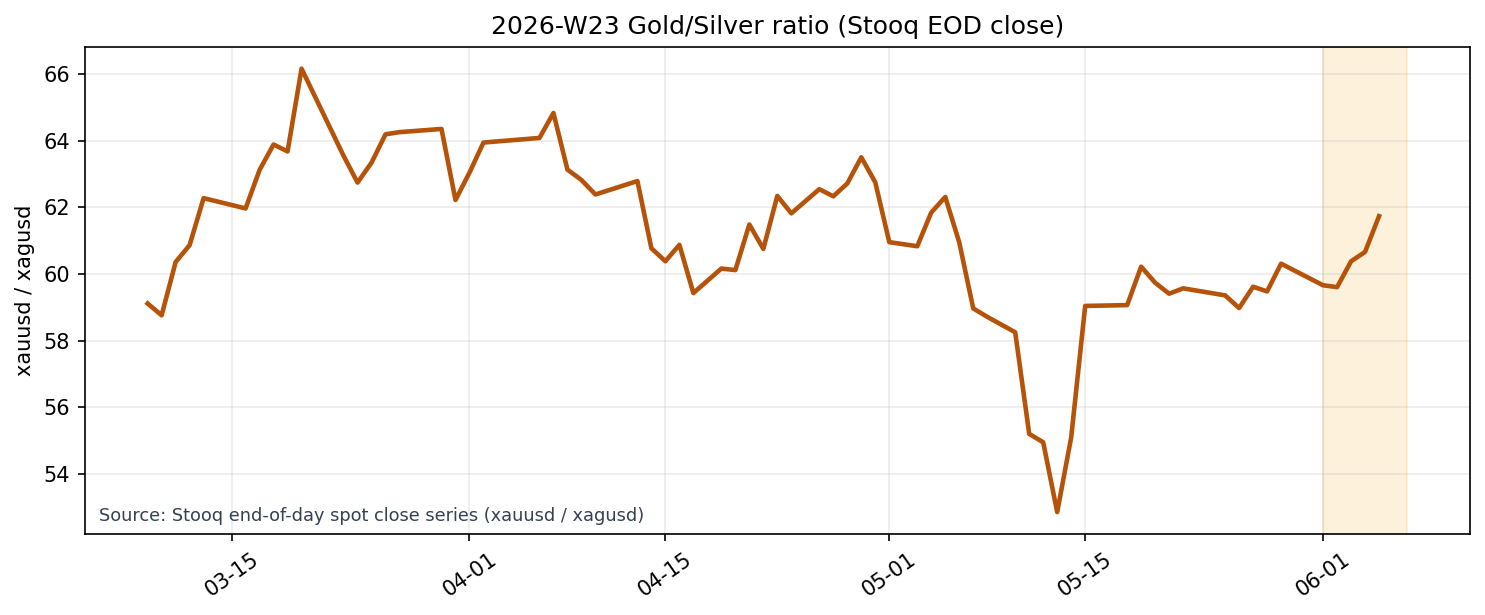
*Source: Stooq end-of-day spot close series (xauusd / xagusd).
In interpreting price charts, spot series are treated as Stooq-based data. In the weekly_inputs weekly snapshots, gold began at $4,523.5 on June 1, 2026, and closed at $4,489.4 on June 5, a -0.75% change from the previous week. This week shows renewed weakness, contrasting with last week's W22 which saw a slight rebound of +0.27%. However, the decline was not a sharp drop. The weekly high reached $4,541.4 and the low was $4,427.2, resulting in a range of $114.2 and an increase of 2.52% from the opening price. This is significantly narrower than last week's W22 range of $219.1, suggesting more of a consolidation period around the $4,500 level rather than a substantial decline.
The annualized volatility was 16.18%, with a percentile ranking of 59.59 over the past three years. This represents a further decrease from last week's 17.37%, indicating that market heat is declining despite weak prices. The closing price level stands at the 86.87 percentile, which remains relatively high, placing it within the top 13% of levels observed over the past three years. Conversely, the three-month return is -12.56%, while the one-year return is +35.53%. This suggests that a long-term upward trend persists, but short-term consolidation near recent highs continues. Last week's report identified whether the level of $4,500 could be maintained as a key point to watch; however, the answer remains somewhat inconclusive. The closing price was 4,489.4 dollars, slightly breaching this level, and a strong rebound has not yet been confirmed.
In terms of ratios, the gold-silver ratio was 61.74, a +2.37% change from the previous week. However, the three-year percentile remains quite low at 9.91, suggesting that a silver-dominant market trend still persists over the longer term. It’s more accurate to interpret this as the ratio retracing due to a slight pullback in silver's strength, rather than gold outperforming alone. While maintaining high price levels, volatility has decreased and the ratio is poised for a rebound. This combination indicates a compression phase exploring the next direction, rather than the initial movement of a breakdown.
③ Investor Activity of Institutional Investors
Institutional investor supply and demand has improved somewhat beyond what the price action suggests. The CFTC's money manager net position as of May 26 was 97,446 contracts, an increase of 3,906 contracts from the previous week’s 93,540 on May 19. Previously, the weakness stemmed from "COT (Commitment of Traders) not following price reversals," but this situation has temporarily reversed this week. Long positions totaled 124,277 contracts, short positions 26,831 contracts, and total open interest 353,489 contracts. The increase in net positions during a week with slight price declines indicates that speculative investors have not completely exited the market.
The COT (Commitment of Traders) levels remain only at the 29.68th percentile over the past three years. Looking back over the last three years, it's still within the bottom 30%, and positions are not at all crowded. This is important; currently, gold is maintaining a state where "it’s at a high price but speculation isn't overheated." This can easily lead to a lack of upward momentum in the short term, but conversely, it also means there's little risk of a collapse due to selling from overextended positions. One confirmation point we set for W22 was “will the COT net position reverse direction from 93,540 contracts?” This point has been cleared in a recovery direction.
The 60-day beta remains at 0.54, and the 252-day beta is a low 0.05. There has been no significant change in the pattern where this product is selected primarily as a diversification asset rather than directly tracking the risk-on sentiment of high-tech stocks. Therefore, the focus for next week will be whether the recent COT reversal proves to be just that, or if speculative buying continues while prices consolidate around $4,500. If the latter, then this week’s weak closing prices may prove to be a lagging indicator.
④ Macro Factors Check
Macroeconomic factors are slightly more supportive of gold than last week. The key indicator for real interest rates, our proxy, decreased to 2.06%, down from 2.09% in W22. While the focus remained on whether "deterioration is stopping," we've seen a further slight improvement this week. The dollar index DXY stands at 119.29, which is low, falling within the 3rd percentile (13.92). It’s also down -1.55% year-on-year, indicating that structural upward pressure on the dollar has not reaccelerated. Both factors most detrimental to gold – the dollar and real interest rates – have not been headwinds this week.
Meanwhile, U.S. 10-year nominal interest rates are at 4.45%, placing them at the 81.27th percentile, and the 10-year breakeven inflation is at 2.38%, also at the 83.98th percentile. Neither nominal interest rates nor expected inflation are particularly low, so the macroeconomic environment isn't a comprehensive tailwind. The VIX is settled at 15.74, and high-yield OAS remains at 2.75%, placing it at the 11.73rd percentile. It’s reasonable to understand that this wasn't a week where gold was bought due to credit concerns or a clear risk-off sentiment. WTI is at $97.63, a high level corresponding to the 95.39th percentile, but decreased by -2.71% compared to the previous week. Overall, this week’s gold prices were not driven by crisis buying, but rather held up due to a generally weaker dollar and a slight decline in real interest rates.
⑤ Supply and Demand and Sentiment
Supply and sentiment show a mixed picture of slight improvement and weakness compared to the previous week. This week’s gold-related news totaled 33 articles, up from 30 the prior week. Key topics included corporate developments, finance, policy, geopolitics, and investment flows. However, the weekly average of the primary indicator, site-adjusted sentiment, remains negative at -0.234. While this represents an improvement from last week’s W22 level of -0.288, a sustained bullish trend has not yet been established. The most recent value is +0.08, a clear rebound from the previous Friday's -0.30. The raw score average also increased to 1.125621, up from last week’s 0.716, suggesting a slightly brighter outlook for the underlying news tone.
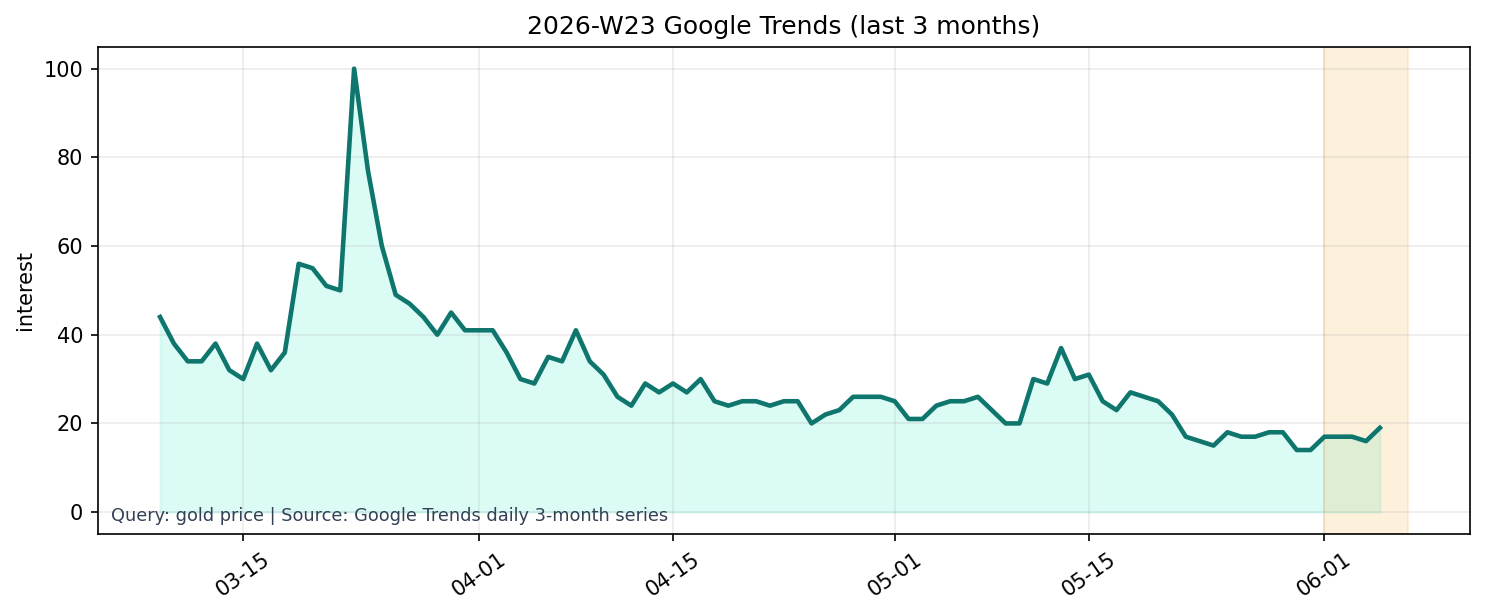
Source: Google Trends daily 3-month series (gold price)
Google Trends data for gold price showed a recent value of 19 for the three-month series, up +18.75% from the previous week. The one-year series registered 20, unchanged from the prior week. However, the three-year percentile for the one-year series remains at 26.87, indicating that search demand is still relatively low. While the closing price’s three-year percentile is high at 86.87, searches remain close to the bottom quartile over the past three years. This discrepancy has not changed significantly from the previous week. Commitment of Traders (COT) data showed a slight pullback, and recent sentiment shifted positive; however, weekly average sentiment remains weak, and search demand has not increased. In essence, the current gold market is characterized by participants holding positions with cautious uncertainty, neither panic selling nor exuberance.
⑥ This Week’s Insights and Next Week’s Key Points
Last week (W22), we focused on three key points: 1. Whether the real interest rate proxy would fall further below 2.09%, 2. whether the Commitment of Traders (COT) net position would stabilize from 93,540 contracts, and 3. whether corrected sentiment would return to neutral territory from -0.288. The results were two successes and one failure. The real interest rate proxy declined to 2.06%, and the COT net position increased to 97,446 contracts. However, weekly average sentiment improved to -0.234 but has not yet returned to neutral territory. Furthermore, the price itself failed to maintain support in the $4,500s, closing at $4,489.4. This indicates a divergence remains between macro and speculative factors (showing improvement) and the average psychological sentiment and the appearance of prices (which remain weak).
The current hypothesis derived from this combination is clear. Gold's recent price action suggests that the underlying fundamentals are beginning to improve rather than a simple break of an upward trend. Despite falling real interest rates, a weak dollar, and a shift to increasing positions in the Commitment of Traders (COT) report, search activity and weekly sentiment remain sluggish – indicating a cautious pullback formation rather than premature optimism. However, for this hypothesis to be validated, prices must confirm this movement in the coming weeks. If price action doesn't reflect supply and demand improvements, a move below $4,500 could signify more than just noise; it would represent an entry point for further downside revisions.
Here are three key points to watch next week. First, will the real interest rate proxy decline further, staying around 2.06%, or at least not re-ascend? Second, will the COT net long position recovery of 97,446 contracts continue beyond a one-week trend and move towards 100,000 contracts? Third, can the weekly average of adjusted sentiment return from -0.234 to neutral territory? From a price perspective, it will also be important whether gold can clearly recover above $4,500 and end the week there. Overall, this week's gold has been "weak in price but slightly improved in substance." Next week will be crucial for determining if this discrepancy is resolved and whether prices and supply/demand move in the same direction.