Lithium Basic Statistics
Last updated: 2025-02-24
Compiled from USGS MCS 2026 and selected public supplements. Domestic U.S.-only notes are excluded where possible.
1. Highlights & Overview
- World production (2025) is approximately 290,000 t.
- Global reserves are approximately 37,000,000 t.
- The largest producer is Australia, accounting for about 31.7% of global output.
- In 2025, Australia ranked among the top producers (92,000).
- The top 3 countries account for about 72.4% of global output, indicating concentrated supply.
- Source: USGS MCS 原文PDF
- Source: Australia REQ Dec 2025 (PDF)
- Source: Australia REQ Dec 2025 Forecast data (xlsx)
- Source: Australia REQ Dec 2025 Historical data (xlsx)
2. Price Trends & Global Market (Events, Trends, and Issues)
- Excluding U.S. production, worldwide lithium production in 2025 increased by 31% to approximately 290,000 tons from 222,000 tons in 2024 in response to strong demand from the lithium-ion battery market, high lithium prices from 2021 to early 2023, and an increase in global lithium production capacity.
- Global consumption of lithium in 2025 was estimated to be 263,000 tons, a 20% increase from consumption of 220,000 tons in 2024.
- Concern about a short-term lithium oversupply kept prices low during the first half of 2025.
- However, considerable EV sales growth in China and Europe and increased demand for battery energy storage systems contributed to lithium price increases during the second half of 2025.
Usage Mix (Based on Public Data)
3. World Mine Production and Reserves
Top Producing Countries(2025, Top 5)
Top Reserves (Top 5)
| Country | Production(2025) | Reserves |
|---|---|---|
| Australia | 92,000 | 68,400,000 |
| China | 62,000 | 4,600,000 |
| Chile | 56,000 | 9,200,000 |
| Zimbabwe | 28,000 | 500,000 |
| Argentina | 23,000 | 4,400,000 |
| Brazil | 12,000 | 540,000 |
| Mali | 9,400 | 370,000 |
| Canada | 5,600 | 1,600,000 |
| Portugal | 380 | 60,000 |
Unit: トン
4. Supply-Demand Balance Trend
Unit: LCE kt / Positive values indicate supply surplus; negative values indicate supply deficit.
5. Metallurgical & Physical Properties and Industrial Uses
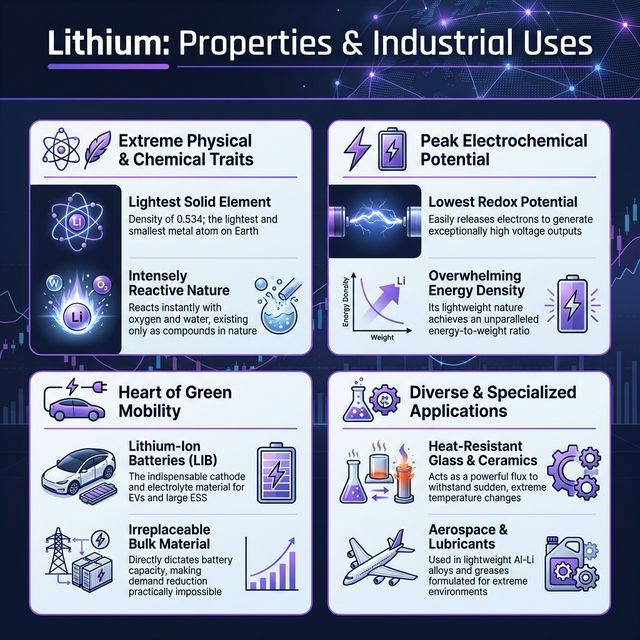
Lithium (Li) belongs to the Group 1 alkali metals and is the lightest (density 0.534 g/cm³) and smallest metal atom among all solid elements [33]. It is a soft, silvery-white metal, but because it is extremely reactive and poses a risk of instant ignition and explosion upon reacting with oxygen or moisture in the atmosphere, it never exists as a pure metal in nature. Instead, it is always found as a compound, such as within silicate minerals like pegmatite or dissolved as ions in the brine of salt lakes [33].
The greatest metallurgical and electrochemical characteristic of lithium is that it has the lowest standard oxidation-reduction potential of all elements (approximately -3.04 V) [34]. This signifies an extremely strong tendency to release electrons and become an ion, meaning that when used as an anode material in batteries, a very high voltage can be extracted. Furthermore, because of its small atomic weight and lightness, it can dramatically increase the energy density per unit of weight.
Due to this high electrochemical potential, the largest contemporary industrial application for lithium is as the cathode and electrolyte material in "lithium-ion secondary batteries (LIBs)" used for mobile devices, electric vehicles (EVs), and energy storage systems (ESS) for renewable energy power grids [34]. Lithium serves as the de facto heart of global mobility electrification and green energy storage [34].
However, even before the explosion of battery demand, lithium possessed diverse traditional industrial applications. Because it has the effect of drastically lowering the coefficient of thermal expansion, it is indispensable as a powerful flux for heat-resistant oven glass and ceramics that must withstand rapid temperature changes [33]. Additionally, lithium stearate, which maintains its viscosity even at high temperatures, is an exceptionally excellent lubricating grease for aircraft and automotive bearings [34]. In the aerospace industry, aluminum-lithium (Al-Li) alloys—created by adding a small amount of lithium to aluminum—are heavily utilized as next-generation structural materials that achieve both high rigidity and significant weight reduction [36]. In the medical field, lithium carbonate has long been used as a mood stabilizer to manage psychiatric disorders such as bipolar disorder [33].
6. Structural Issues Governing Supply and Demand
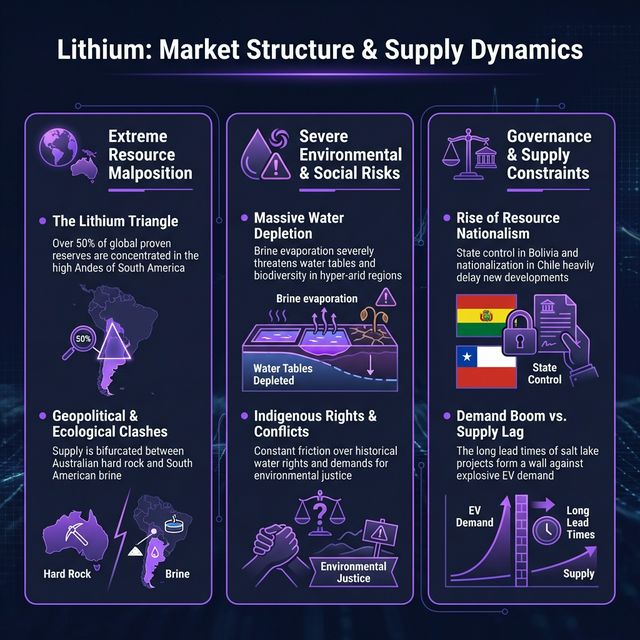
Because the lithium market stands at the very forefront of the "Energy Transition," it is exposed to extremely violent supply-demand fluctuations, as well as geopolitical and environmental risks.
The first special circumstance is the intense localized concentration of resources and the subsequent "political ecology" clashes. Lithium resources are primarily divided into hard rock (spodumene from pegmatite ores) found in places like Australia, and salt lake brine found in South America [33]. In particular, the high altitude region of the Andes Mountains where the borders of Argentina, Bolivia, and Chile intersect is known as the "Lithium Triangle," holding over 50% of the world's confirmed reserves [35].
The lithium extraction process from brine in this Lithium Triangle harbors severe environmental and social risks (ESG risks). The method employed involves pumping brine from deep underground into expansive evaporation ponds, where sunlight and wind are used to evaporate and concentrate the water over a period of several months to a year [37]. This process entails consuming (evaporating) "massive amounts of water" in an extremely arid region, devastating the fragile Andean hydrological system (underground aquifers) and causing localized water resource depletion [35]. Consequently, not only are the habitats of endemic species like flamingos threatened, but the living rights and water rights of indigenous communities who have historically farmed and raised livestock on that land are also snatched away. This has led to endless and severe social conflicts and disputes centered around environmental justice [35].
Furthermore, differences in governance and political structures elevate supply uncertainty. Bolivia boasts the Uyuni Salt Flat, one of the world's largest resources, but because it adheres to a state-led development policy grounded in staunch resource nationalism, the introduction of foreign capital has been delayed, making the ramp-up of commercial production extremely sluggish [35]. Chile had previously advanced development through private sector initiatives, but recent regime changes have led to the launch of a National Lithium Strategy, moving toward tighter regulations geared toward state ownership [35]. In this way, the political agendas of resource-holding nations and the strict enforcement of ESG requirements serve as structural barriers that obstruct the agile expansion of supply in response to growing demand [35].
On the demand side, alongside the progression of the EV transition, lithium demand is undergoing nonlinear, explosive growth. According to scenarios by the International Renewable Energy Agency (IRENA), achieving the 2050 climate stabilization target (the 1.5°C goal) will require a lithium mining infrastructure on an astronomical scale that far surpasses current supply levels [39]. Unlike catalytic metals such as platinum, lithium is a bulk material that physically constitutes the battery's "capacity (energy storage amount)" itself, meaning there is a thermodynamic limit to how much its usage can be reduced (thrifting). Therefore, supply infrastructure (especially salt lake development, which has long lead times) cannot catch up with the sudden surges in demand, making structural supply deficits and the ensuing violent price volatility a permanent special circumstance of the market [34].
References
- [33] Lithium - USGS Publications Warehouse - USGS.gov
- [34] Global Lithium Sources---Industrial Use and Future in the Electric Vehicle Industry: A Review
- [35] The Impact of Environmental and Social Challenges of \... - kth .diva
- [36] A review of manufacturing processes, mechanical properties and precipitations for aluminum lithium alloys used in aeronautic applications - PMC
- [37] Co-Management and Power Dynamics within The Lithium Triangle - ArcGIS StoryMaps
- [39] Geopolitics of the Energy Transition: Critical Materials - IRENA