Platinum Basic Statistics
Last updated: 2025-02-24
Compiled from USGS MCS 2026 and selected public supplements. Domestic U.S.-only notes are excluded where possible.
1. Highlights & Overview
- World production (2025) is approximately 170,000 kg (PGM contained).
- Global reserves are approximately 76,000,000 kg (PGM contained).
- The largest producer is South Africa, accounting for about 70.6% of global output.
- In 2025, South Africa ranked among the top producers (120,000).
- The top 3 countries account for about 92.9% of global output, indicating concentrated supply.
- Source: USGS MCS 原文PDF
- Source: WPIC Platinum Quarterly
- Source: WPIC Platinum Essentials
- Source: WPIC PQ Tables (xlsx)
2. Price Trends & Global Market (Events, Trends, and Issues)
- In 2025, production of PGMs in South Africa, the world’s leading producer of PGM- containing mined material, decreased by an estimated 9% compared with that in 2024 owing to declining palladium prices, higher costs associated with deep-level mining, and ongoing disruptions to the supply of electricity.
- Estimated production in Russia, the world’s leading producer of mined palladium, decreased by 6% owing to lower metal grades and ore recovery, geopolitical and investor uncertainty related to the Russia-Ukraine conflict, and the introduction of new mining equipment at one operation.
- The estimated annual average price in 2025 increased by 53% for ruthenium, by 25% for platinum, by 24% for rhodium, and by 11% for palladium compared with the average prices in 2024.
- The estimated annual price of iridium decreased by 9% compared with annual average price in 2024.
Usage Mix (Based on Public Data)
3. World Mine Production and Reserves
Top Producing Countries(2025, Top 5)
Top Reserves (Top 5)
| Country | Production(2025) | Reserves |
|---|---|---|
| South Africa | 120,000 | 63,000,000 |
| Russiae | 20,000 | 11,000,000 |
| Zimbabwe | 18,000 | 1,300,000 |
| Canada | 5,000 | 310,000 |
| United States | 1,800 | 590,000 |
Unit: kg(PGM含有量)
4. Supply-Demand Balance Trend
Unit: koz / Positive values indicate supply surplus; negative values indicate supply deficit.
5. Metallurgical & Physical Properties and Industrial Uses
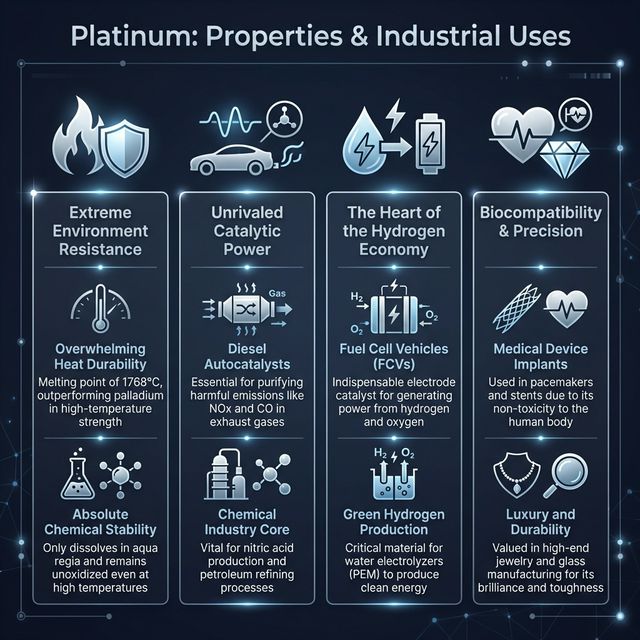
Platinum (Pt) is a noble metal that represents the Platinum Group Metals (PGMs: Pt, Pd, Rh, Ru, Ir, Os), and its physical and chemical properties are optimized for industrial applications in extreme environments. It has a remarkably high melting point of 1,768°C, maintaining excellent mechanical strength under high-temperature conditions [18]. High-temperature tensile and creep tests comparing it to palladium have demonstrated that platinum exhibits superior high-temperature durability [19]. Furthermore, it boasts absolute corrosion resistance and chemical stability; it does not dissolve in acids other than aqua regia, nor does it oxidize at all even in high-temperature air [18].
However, the property most highly prized industrially—one considered irreplaceable—is its unparalleled "catalytic activity" [18]. The electron orbital structure of platinum gives it the ability to adsorb specific gas molecules (such as hydrogen, oxygen, carbon monoxide, and hydrocarbons) onto its surface, drastically lowering the activation energy required for molecular bonds.
The largest application utilizing this catalytic property is the automotive catalytic converter (autocatalyst) for exhaust gas purification [20]. Particularly in the process of oxidizing carbon monoxide (CO) and unburned hydrocarbons (HC)—which are contained in the exhaust of diesel engines that combust in an oxygen-excess (lean) state—and converting them into harmless carbon dioxide and water, platinum demonstrates the highest efficiency [21].
In recent years, the sector expected to experience the most explosive growth relates to the "Hydrogen Economy." In proton exchange membrane fuel cells (PEMFCs), platinum is used as an electrocatalyst on both the anode (hydrogen oxidation) and the cathode (oxygen reduction), playing the role of the heart that efficiently extracts power from hydrogen [22]. Moreover, in proton exchange membrane electrolyzers (PEMEL), which utilize the reverse reaction to produce green hydrogen from renewable energy, platinum is an indispensable cathode catalyst [22].
Other industrial applications are incredibly diverse, including crucibles for drawing glass fibers and thermocouples (leveraging its high-temperature chemical stability), naphtha reforming catalysts in oil refining, curing catalysts for silicone resins, and even inside the medical field as components in anti-cancer drugs (such as cisplatin) and electrodes for pacemakers [20].
6. Structural Issues Governing Supply and Demand
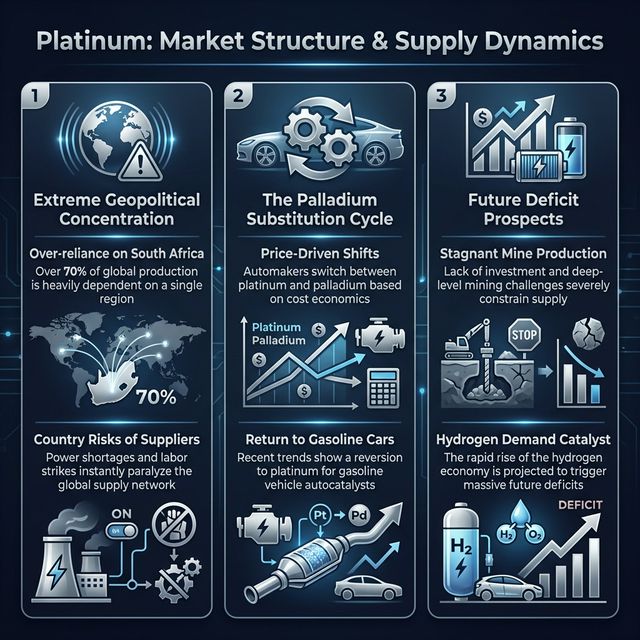
The supply-demand balance of platinum is governed by three multi-layered special circumstances: "extreme geopolitical maldistribution," "substitution dynamics with palladium," and "the minor metal (iridium) bottleneck accompanying the hydrogen economy."
The first special circumstance is supply vulnerability. Global platinum mine production is extremely concentrated geopolitically, with over 70% of world production coming solely from the Bushveld Igneous Complex in South Africa [18]. Due to this overwhelming concentration in a single nation, South Africa's domestic issues—such as chronic planned blackouts (load-shedding) by the state-owned power utility Eskom, severe labor strikes, and rising costs due to the aging and deepening of mines—harbor the constant risk of instantly paralyzing the entire global platinum supply chain [18]. While production also occurs in Zimbabwe and Russia, it is not on a scale large enough to offset fluctuations in South African supply capacity.
The second factor is the cycle of "substitution" and "reverse substitution" with palladium (Pd), a fellow PGM. In automotive exhaust catalysts, platinum and palladium have similar chemical properties, allowing them to be substituted for each other at a certain ratio [25]. In the past, when platinum prices surged significantly against palladium, automakers massively substituted the platinum in gasoline engine catalysts with cheaper palladium to cut costs [25]. Historically, palladium's catalytic efficiency was considered inferior to platinum, requiring a ratio of "2 parts palladium for every 1 part platinum," but advancements in low-sulfur fuel technologies enabled a 1:1 substitution [27]. However, in recent years, as the palladium market fell into a prolonged deficit and prices inverted (with palladium becoming more expensive than platinum), a "reverse substitution" from palladium back to platinum is currently underway [26]. This substitution process translates into more than merely a change of materials; it requires the redesign of engine exhaust calibrations and re-certification by environmental regulatory agencies in each country, generating a lead time of several years. As a result, the reaction of demand to price signals lags, creating a structure that amplifies market volatility [26].
The third, and potentially most severe special circumstance in the future, is the "iridium curse" accompanying the energy transition. Final investment decisions (FIDs) for large-scale proton exchange membrane electrolyzer (PEMEL) projects intended for green hydrogen production are surging, particularly in Europe. Consequently, hydrogen-related platinum demand is forecast to skyrocket from approximately 40,000 ounces in 2023 to 476,000 ounces in 2028 [28]. However, the PEMEL anode catalyst strictly requires iridium oxide (IrO2) as the only material capable of withstanding the extreme corrosive environment of strong acidity and high potential [29]. Iridium is produced solely as a minuscule by-product of platinum mining, with an annual global production of merely 7.5 tons [29]. Considering the scale of PEMEL deployment required to achieve net-zero targets, iridium demand would easily exceed 30% of global production, indicating a potential fatal supply shortage before 2030 [29]. In other words, even if platinum supply itself is sufficient, the depletion of its by-product, iridium, presents a highly unique supply chain risk that could physically halt the infrastructure rollout of a hydrogen economy that consumes massive amounts of platinum [29].
References
- [18] Platinum-group elements: So many excellent properties - USGS Publications Warehouse
- [19] Investigation of mechanical and structural characteristics of platinum and palladium at high temperatures \| Revista de Metalurgia
- [20] Recovery of Precious Metals from High-MgO-Content Pt-Pd Concentrates Using a Pyrometallurgical Smelting Process - MDPI
- [21] A Study of Platinum Group Metals in Three-Way Autocatalysts - ResearchGate
- [22] Hydrogen Demand - About Platinum - World Platinum Investment Council -- WPIC®
- [25] A Review of Recovery of Palladium from the Spent Automobile Catalysts - MDPI
- [26] Platinum for palladium substitution is embedded into automotive demand and unlikely to reverse swiftly
- [27] Substitution among Platinum Group Metals - CME Group
- [28] Policy certainty is accelerating hydrogen electrolyser approvals and supporting platinum\'s investment case
- [29] Critical Iridium Demands arising from future Expansion of Proton Exchange Membrane Electrolysis - arXiv